

For anyone investing in Chennai real estate today, the biggest question isn’t where to buy it’s what to buy. Land or apartment? Both are seen as safe investments, both are widely recommended, and both come with strong opinions. But most decisions are still driven by emotion, not numbers.
The truth is, land and apartments behave very differently as financial assets. One offers appreciation without cash flow. The other generates rental income but comes with maintenance, depreciation, and liquidity considerations. Without looking at ROI, rental yield, resale speed, and long-term risk together, it’s easy to assume both investments perform the same when they rarely do.
This guide breaks down land vs apartment in Chennai using only practical math ROI, liquidity, rental returns, and risk. No hype, no generic advice. Just clear numbers and decision logic to help you choose the asset that actually matches your investment goals.
Chennai Real Estate Investment Mindset Is Changing
Chennai’s real estate market has traditionally been driven by emotional buying – purchasing land for status, buying apartments for convenience, or investing based on family recommendations. But over the last few years, this mindset has started to shift. Buyers are now thinking less like homeowners and more like investors.
Rising property prices, loan costs, and maintenance expenses have made investors more cautious. Instead of simply asking “Is this a good property?”, buyers are asking smarter questions:
- What is the long-term ROI?
- How liquid is this asset?
- Will it generate rental income?
- What risks am I taking over 10–15 years?
This shift toward data-driven decision-making is reshaping investment in Chennai real estate. Investors now compare land and apartments the same way they would compare financial assets – based on performance, risk, and long-term wealth potential rather than emotional appeal.
Recent insights around chennai market reality highlight how appreciation patterns, infrastructure growth, and buyer demand are changing how investors evaluate property choices. Land is increasingly viewed as a long-term capital asset, while apartments are evaluated for rental yield and liquidity.
As a result, the question is no longer “Which is better?” but “Which fits your financial objective?”
Understanding this shift is the first step before comparing ROI, rental returns, liquidity, and risk in real numbers.
ROI Comparison – Land vs Apartment (Actual Numbers)
Return on investment is the first metric serious buyers look at and this is where land and apartments behave very differently. Both can create wealth, but the path they take and the time required are not the same.
Land is typically a capital appreciation play. It rarely generates monthly income but can deliver strong value growth over time, especially in developing corridors and plotted communities. Apartments, on the other hand, combine moderate appreciation with rental yield, creating a hybrid return model.
When comparing land vs apartment in Chennai, ROI should be evaluated across three areas:
- Capital appreciation over 10–15 years
- Rental income potential
- Ongoing expenses and maintenance
- Resale value and transaction costs
ROI Comparison – Land vs Apartment
| Factor | Land | Apartment |
| Capital appreciation | High (long-term) | Moderate |
| Rental income | None | 2–4% annual yield |
| Maintenance cost | Minimal | Continuous expense |
| Loan dependency | Lower (often) | Higher |
| 10–15 year ROI potential | Strong if location grows | Stable but capped |
Land tends to outperform in long-term appreciation if purchased in the right growth corridors. Apartments generate predictable rental income but face depreciation and ongoing maintenance costs that reduce net returns over time.
Insights from investment comparison also show that plotted developments in emerging zones often deliver higher long-term appreciation, while apartments offer shorter-term income stability.
The key takeaway:
ROI is not just about appreciation or rent alone. It’s about how each asset performs across time, cost, and resale value which is exactly what we’ll break down next through rental income, liquidity, and risk.
Rental Income Reality – Where Cash Flow Actually Comes From
For investors who want monthly cash flow, rental income becomes a major deciding factor. This is where apartments clearly have an advantage over land. While land can appreciate significantly over time, it typically does not generate any regular income unless developed or leased commercially.
Apartments, especially in well-connected parts of Chennai, can produce steady rental returns. However, the actual income after expenses is often lower than expected. Maintenance charges, vacancy periods, and periodic repairs reduce net rental yield, making it important to evaluate realistic numbers rather than optimistic projections.
When comparing rental potential, consider
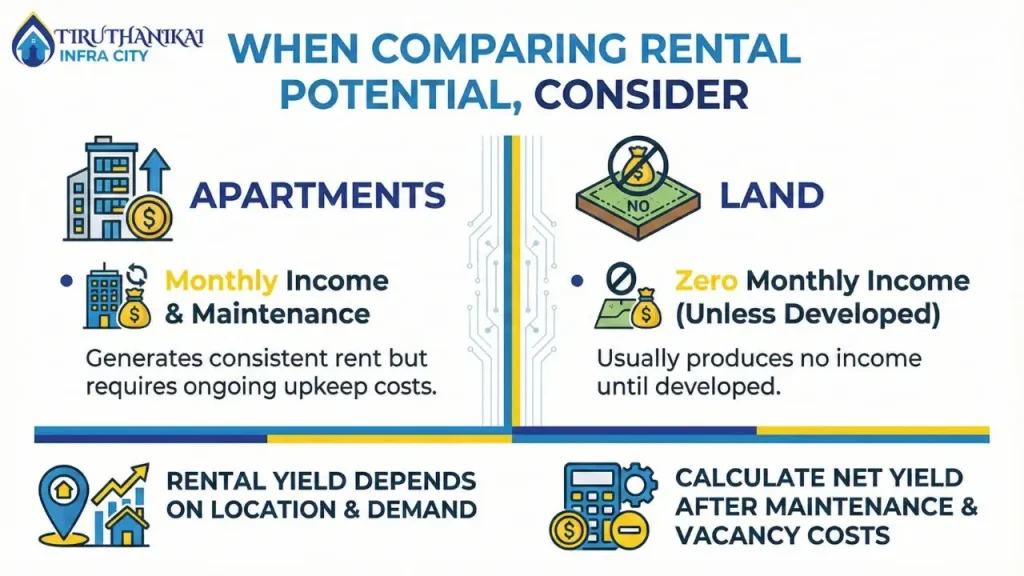
- Apartments generate monthly rental income but require ongoing maintenance
- Land usually produces zero monthly income unless developed
- Rental yield depends heavily on location and demand
- Net yield must be calculated after maintenance and vacancy costs
Typical rental realities in Chennai
- Average apartment rental yield: 2%–4% annually
- Premium locations: slightly higher demand but higher purchase cost
- Peripheral areas: lower cost but inconsistent rental demand
- Land: no recurring income unless leased or developed
According to recent rental yield data, Chennai’s rental returns remain stable but modest compared to property prices. This means apartments work best for investors seeking steady cash flow rather than aggressive appreciation.
The takeaway is simple:
If monthly income is your primary goal, apartments offer predictable returns. If long-term appreciation is the goal, land often performs better but without immediate cash flow. Understanding this difference is essential before evaluating liquidity and resale potential.
Liquidity – Which Asset Can You Sell Faster?
Liquidity is one of the most underestimated factors in real estate investment. Many buyers focus on purchase price and appreciation but overlook how easily the asset can be sold when cash is needed. In reality, the speed of resale can significantly affect overall ROI.
Apartments generally have higher liquidity in urban areas because they cater to both investors and end users. Banks readily offer home loans for flats, which increases the buyer pool and makes resale transactions smoother. Land, however, depends heavily on location, plot approval status, and surrounding development before attracting buyers.
Many investors assume land automatically becomes more valuable over time and therefore easier to sell. But liquidity doesn’t depend only on appreciation it depends on demand, affordability, and financing access.
What investors misunderstand about property liquidity
Key factors that influence property liquidity include:
- Buyer demand: Apartments attract end-users and investors, increasing resale chances
- Loan eligibility: Flats are easier to finance; land purchases often require higher cash
- Ticket size: High-value land parcels reduce the number of potential buyers
- Location maturity: Developed areas sell faster than emerging outskirts
In Chennai, apartments in established residential zones tend to sell faster due to ready-to-move demand and loan accessibility. Land can deliver strong appreciation but may take longer to liquidate unless located in a rapidly developing corridor.
For investors focused on flexibility and faster resale, apartments offer stronger liquidity. For those willing to hold long term without immediate resale pressure, land can still be a powerful wealth asset provided the location and legal clarity are strong.
Risk Analysis Legal, Market & Maintenance Risk
Every real estate investment carries risk. The difference between a smart investment and a stressful one often comes down to understanding where those risks actually lie. When comparing land vs apartment in Chennai, risk appears in different forms legal, market-driven, and ongoing maintenance-related.
Land is often seen as the safer asset because it doesn’t depreciate physically. However, its biggest risks are legal and location-based. Apartments, while legally structured and easier to finance, come with long-term maintenance costs and potential value stagnation depending on age and supply.
Key risks to evaluate before choosing either asset include
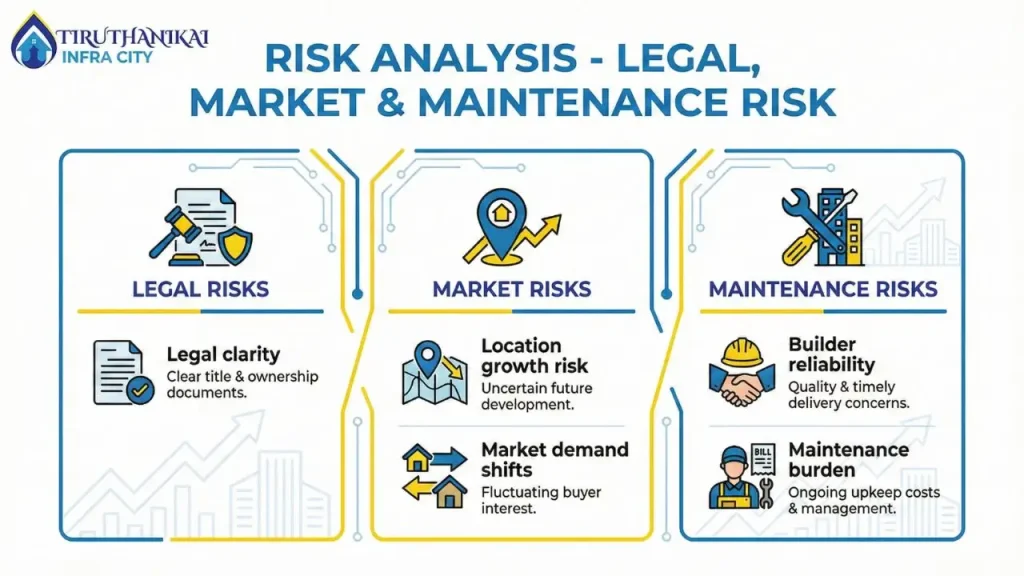
- Legal clarity: Land requires detailed verification of title, approvals, and zoning
- Location growth risk: Appreciation depends heavily on infrastructure development
- Builder reliability: Apartment value depends on construction quality and reputation
- Maintenance burden: Flats incur ongoing association and repair costs
- Market demand shifts: Oversupply in certain zones can slow resale or rental demand
Land investments demand stronger due diligence upfront. A clear title, approved layout, and growth potential are essential to reduce legal and resale risk. Apartments, meanwhile, shift risk toward long-term upkeep and depreciation, especially after 10–15 years when buildings age and maintenance rises.
Understanding these risks helps investors avoid costly surprises and align their purchase with their time horizon and financial goals. Once risk is clear, the next step is evaluating long-term wealth creation over 10–20 years where the real math of property investment becomes visible.
Long-Term Wealth Creation – 10 to 20 Year Math
Long-term wealth in real estate is created not by short-term price movement, but by how an asset behaves over a decade or more. This is where land and apartments diverge most clearly. Appreciation, rental income, maintenance cost, and exit value together determine whether an investment truly compounds wealth.
Land typically performs best over longer holding periods, especially when purchased in growth corridors before infrastructure fully matures. Apartments, while generating rental income, often see appreciation slow down after a certain point due to aging, increased supply, and rising maintenance expenses.
When investors evaluate land vs apartment in Chennai over a 10–20 year horizon, these factors matter most:
- Total capital appreciation over the holding period
- Net rental income after expenses
- Cumulative maintenance and association costs
- Ease of resale and price realization at exit
Long-Term Wealth Outcome Comparison
| 15-Year Scenario | Land | Apartment |
| Capital appreciation | High (location-driven) | Moderate |
| Rental income | None | Consistent but capped |
| Maintenance cost | Negligible | High over time |
| Asset depreciation | No | Yes (structure aging) |
| Net wealth creation | Strong if location grows | Stable but limited |
Land tends to reward patience. The absence of depreciation and low holding costs allow appreciation to compound more effectively over time. Apartments provide income stability but often trade off higher maintenance and slower long-term value growth.
Investor confidence also plays a role in long-term decisions. Insights shared through leadership vision reinforce how disciplined location selection and long-term planning shape sustainable wealth creation in plotted developments.
This long-term perspective sets the stage for the most important question: which asset should you choose based on your specific investment goal?
What Should You Choose Based on Your Goal?
There’s no universal winner in the land vs apartment debate. The better investment depends entirely on your financial objective, time horizon, and risk tolerance. When viewed purely through numbers, each asset serves a different type of investor.
If your goal is steady monthly income, apartments usually make more sense. If your focus is long-term wealth creation and capital appreciation, land often performs better. The mistake many investors make is choosing based on trend or advice rather than aligning the purchase with their financial strategy.
Here’s how the decision typically breaks down:
Choose land if your goal is:
- Long-term capital appreciation
- Lower maintenance and holding costs
- Legacy or generational asset creation
- Investment in emerging growth corridors
- Patience for 8–15 year horizon
Choose an apartment if your goal is:
- Monthly rental income
- Easier financing and quicker resale
- Immediate usability or occupancy
- Short- to medium-term investment horizon
- Urban convenience and demand-driven liquidity
Investor experiences also show that clarity of purpose leads to better outcomes. Many buyers who align their purchase with a defined objective rather than market noise – report more satisfaction and stronger returns over time, as reflected in real buyer experiences.
Ultimately, the smarter decision isn’t about choosing land or apartment universally it’s about choosing the asset that aligns with your financial timeline and expected returns. When the objective is clear, the math becomes much easier.
Final Thoughts
Choosing between land and an apartment isn’t about trends or opinions it’s about numbers. Appreciation potential, rental yield, liquidity, and risk all behave differently depending on the asset you choose. When evaluated purely on math, both options can be strong investments, but only when aligned with the right financial objective.
For investors focused on long-term wealth creation and low holding costs, land often delivers stronger appreciation over time. For those prioritizing monthly cash flow and faster resale flexibility, apartments offer predictable returns and easier liquidity. The key is not which asset is universally better, but which one fits your timeline, risk appetite, and financial goals.
Understanding land vs apartment in Chennai through ROI, rental, liquidity, and risk removes the guesswork from property decisions. When emotion is removed and numbers lead the way, real estate becomes a structured investment rather than a speculative one.
Make Your Next Property Decision With Complete Clarity
Real estate investments perform best when backed by the right guidance, location insights, and long-term planning. Whether you’re considering land for appreciation or apartments for rental returns, a structured approach ensures better outcomes and fewer surprises.
Explore our real estate services to make informed, math-driven property decisions that align with your investment goals and future wealth plans.
FAQs – Land vs Apartment in Chennai
1. Which is better: land vs apartment in Chennai?
It depends on your investment goal. Land typically offers higher long-term appreciation, while apartments provide rental income and better short-term liquidity.
2. What gives better ROI in Chennai – land or flat investment?
Land often delivers stronger long-term ROI if bought in growth corridors. Flats generate steady rental income but usually have moderate appreciation due to depreciation and maintenance costs.
3. Is buying land in Chennai vs apartment safer?
Land carries legal and location-based risk but no depreciation. Apartments are easier to finance and resell but come with maintenance and aging-related value risk.
4. What is the average rental yield for apartments in Chennai?
Most residential apartments in Chennai generate around 2%–4% annual rental yield, depending on location and demand.
5. Does land generate rental income in Chennai?
Typically, no. Residential land does not produce monthly income unless developed or leased commercially.
6. Which has better liquidity in Chennai real estate?
Apartments in established areas usually sell faster because they attract both investors and end-users. Land liquidity depends heavily on location maturity and approval status.
7. Is land a good long-term investment in Chennai?
Yes, especially in developing infrastructure corridors. Land often benefits from capital appreciation over 10–15 years with minimal holding costs.
8. What are the risks of apartment investment in Chennai?
Key risks include maintenance costs, aging buildings, oversupply in certain areas, rental vacancies, and potential stagnation in resale value after 10–15 years.
9. What are the risks of buying land in Chennai?
Land investment risks include legal title issues, approval clarity, infrastructure delays, and slower resale in underdeveloped areas.
10. How should I decide between land vs flat investment?
Define your objective first.
Choose land for long-term appreciation and low maintenance.
Choose an apartment for rental income and easier resale flexibility.