Enquire Now for a free site visit – call
Introduction
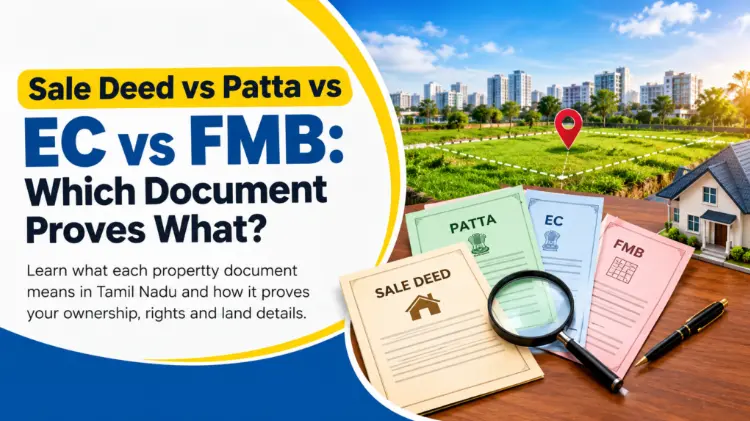
Buying land in Tamil Nadu can look simple—until the documents start telling different stories. A Sale Deed may show one extent, Patta another name, the EC may reveal an earlier transaction, while the FMB can raise questions about boundaries or measurements. That is why checking just one document is risky. Property documents Tamil Nadu can involve multiple records that need careful cross-verification. Tamil Nadu government checklists for property-related approvals can require the Sale Deed, parent documents, updated Patta, FMB, Chitta, Adan gal and an EC covering up to 13 years, showing how important cross-verification is. property documents Tamil Nadu But what exactly does each document prove? In this guide, we break down Sale Deed vs Patta vs EC vs FMB, explain what each record tells you, and show how to compare them before making a property purchase. Understanding property documents Tamil Nadu can help buyers approach document verification more clearly.
What Is a Sale Deed?
A Sale Deed is the key document that records a property sale between a buyer and seller. It identifies the parties, describes the property, states the sale consideration, and records important transaction terms. Property documents Tamil Nadu In Tamil Nadu, government property-related processes may require a Sale Deed along with other supporting records. For example, the Tamil Nadu e-Sevai service list includes Sale Deeds among documents used for certain revenue services. Property documents Tamil Nadu Sale Deed gives you an important starting point for checking a property’s title history. However, don’t rely on it alone. property documents Tamil NaduCompare the deed with parent documents, EC, Patta, survey details, and the property’s actual boundaries before you commit your money. Understanding property documents Tamil Nadu requirements can help you cross-check these records more carefully.
What Information Does a Sale Deed Contain?
A Sale Deed gives you the core details of a property transaction. It generally identifies the buyer and seller, describes the property, states the consideration, and records the terms agreed between the parties. Property documents Tamil Nadu The property description can include the survey number, extent, boundaries, location, and other identifying details. Registration particulars also help connect the deed with the official registration record.
When checking a Sale Deed, compare these details carefully with other property records. Tamil Nadu government documentation specifically lists the Sale Deed alongside parent documents, EC, TSLR, Chitta and Adangal for certain property-related applications.
| Sale Deed Detail | What You Should Check |
|---|---|
| Buyer & Seller | Names and identities |
| Property Description | Survey number and location |
| Extent | Land area |
| Boundaries | Four-side boundaries |
| Consideration | Stated transaction value |
| Registration Details | Document and registration information |
Does a Sale Deed Prove Ownership?
A Sale Deed provides important evidence of a property transaction and forms a central part of the title-document chain. However, buyers should distinguish between having a registered Sale Deed and establishing that the seller has a clear, transferable title to the property. property documents Tamil Nadu The deed should match earlier title documents and supporting records. Tamil Nadu government requirements for certain property approvals illustrate this broader approach: they call for the Sale Deed together with parent documents, EC and revenue records rather than relying on the Sale Deed alone.
| Document | What It Helps You Verify |
| Sale Deed | Current transaction/title documentation |
| Parent Documents | Earlier title history |
| EC | Registered transactions/encumbrances within the search |
| Patta | Revenue-record details |
| FMB | Survey measurements and boundaries |
Before purchasing, ask a property lawyer to examine the complete title chain, especially when records contain mismatches.
Why Should Buyers Check Parent Documents?
Parent documents help you trace how the property reached the current seller. Instead of looking only at today’s Sale Deed, you can follow the earlier transactions and check whether the property description, ownership chain, survey number, and extent remain consistent. property documents Tamil Nadu Tamil Nadu government documentation for certain planning permissions explicitly asks for parent documents since 1975, along with the Sale Deed and other property records.
For example, imagine a seller offers a 2,400 sq. ft. plot. The current Sale Deed shows 2,400 sq. ft., but an earlier document shows a different extent. That difference deserves investigation before you proceed. Similarly, a survey-number or boundary mismatch can signal the need for further verification.
Simple rule: Don’t check only where the property is today—check the document trail that brought it there.
What Is Patta in Tamil Nadu?
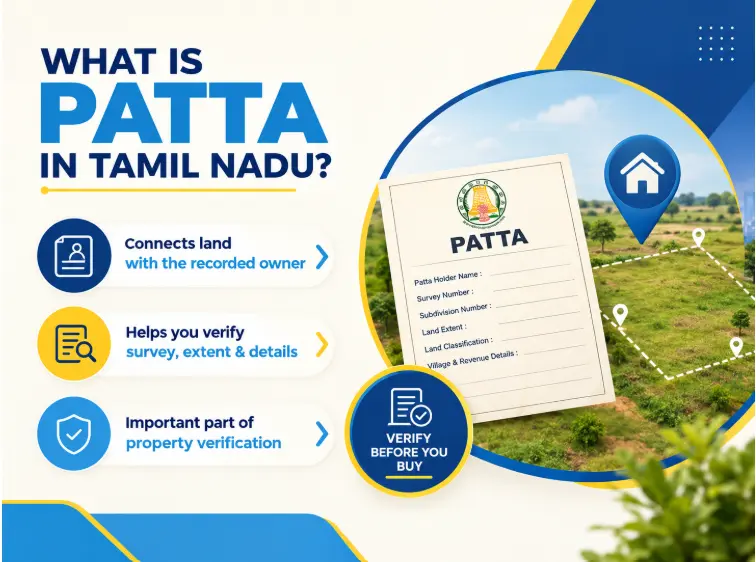
Patta is a revenue record that connects a land parcel with the person recorded for that property. In Tamil Nadu, buyers commonly check Patta along with the Sale Deed, EC, Chitta, Adan gal, and survey records. Patta details can help you verify whether the recorded owner name, survey number, and land extent match the documents you receive from the seller. property documents Tamil Nadu Tamil Nadu’s online building-approval system also compares the extent shown in Patta with the extent in registered documents and the actual site. This makes Patta an important document during property verification. However, treat Patta as one part of the title-checking process rather than relying on it alone.
What Information Does Patta Show?
Patta can help you understand the revenue-record details associated with a land parcel. property documents Tamil Nadu The exact fields can vary depending on the record and property type, but buyers should check key details carefully.
- Patta holder name: The name recorded against the land.
- Survey number: Helps identify the specific parcel.
- Subdivision number: Identifies a divided portion of a survey field.
- Land extent: Shows the recorded area of the property.
- Land classification: Helps identify the recorded nature or category of the land.
- Village and revenue details: Helps connect the property to its administrative location.
Tamil Nadu’s online approval system specifically asks applicants to compare the extent as per Patta, registered documents, and the physical site. This comparison can help identify mismatches before you proceed with a purchase.
Does Patta Prove Ownership?
Patta provides important revenue-record information, but buyers should not treat it as the only proof of ownership. A proper property verification should connect the Patta with registered title documents and other records. property documents Tamil Nadu government checklists also ask for Sale Deed, parent documents, EC, and land records in relevant approval processes.
| Document | What It Helps You Check |
|---|---|
| Patta | Revenue-record holder and land details |
| Sale Deed | Registered property transaction |
| Parent Documents | Earlier title or transfer history |
| EC | Registered transactions and encumbrances within the search period |
| FMB / Survey Records | Measurements, survey details and boundaries |
For example, if the seller’s name appears on Patta but the Sale Deed shows a different owner, investigate the difference before paying an advance.
Why Should Buyers Check the Latest Patta?
Always compare the latest Patta with the seller’s Sale Deed, EC, survey records, and the actual property. property documents Tamil Nadu an outdated Patta can create confusion when ownership, subdivision, or land extent changes. Tamil Nadu’s online approval system even compares the extent shown in Patta with the registered documents and the physical site.
Example: Imagine a seller offers a 2,400 sq. ft. plot. The Sale Deed shows 2,400 sq. ft., but the latest Patta shows 2,000 sq. ft. That 400 sq. ft. difference needs investigation before you proceed.
Also check:
- Seller’s name
- Survey and subdivision numbers
- Land extent
- Property location
- Classification details
A mismatch does not automatically mean the property has a problem, but you should clarify and verify it before completing the purchase.
What Is an Encumbrance Certificate (EC)?
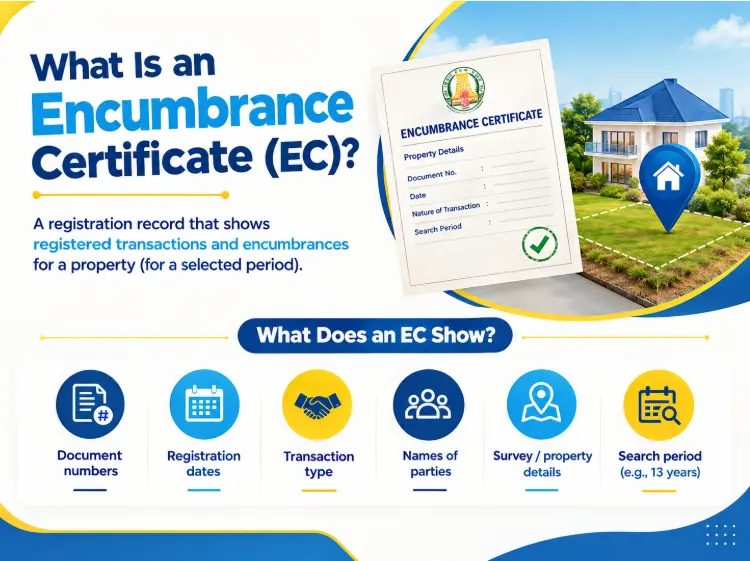
An Encumbrance Certificate (EC) is a registration record that helps you check registered transactions and encumbrances linked to a property for a selected search period. In Tamil Nadu, the Registration Department provides EC issuance and EC download services through the e-Savai system. property documents Tamil Nadu an EC can help you identify registered sales, mortgages, releases, settlements, or other transactions recorded against the property. property documents Tamil NaduThe search period matters because an EC only covers the records included in that search. For example, a current Tamil Nadu online building-approval checklist asks for an EC covering the past 13 years for that specific process. Always compare the EC with the Sale Deed, parent documents, Patta, and other title records before buying property.
What Does an EC Show?
An EC mainly shows registered transactions or encumbrances recorded against a property during the selected search period. It can help you understand whether the Registration Department’s records contain transactions connected with the property.
When reviewing an EC, look for:
- Document numbers linked to registered transactions
- Registration dates of those transactions
- Nature of transaction, such as sale, mortgage, settlement, or release
- Names of parties connected with the transaction
- Survey or property details used to identify the land
- Search period covered by the certificate
The search period plays an important role. For example, Tamil Nadu’s current online building-approval checklist asks for an EC covering 13 years for that particular approval process. property documents Tamil Nadu This does not mean every property purchase requires exactly 13 years. Choose the search period based on the property and transaction and compare the EC with the complete title-document chain.
What Can You Check in an EC?
An EC can help you review the property’s registered transaction history within the period you search. Before buying, don’t just look for the words “No Encumbrance. “Property documents Tamil Nadu Read the entries and compare them with the seller’s documents.
Check these points:
- Seller/owner names — Do the names match the relevant documents?
- Document numbers — Can you match listed transactions with registered copies?
- Transaction type — Look for sales, mortgages, settlements, releases, or other registered dealings.
- Registration dates — Check when each transaction occurred.
- Survey details — Compare survey numbers and property identification details.
- Search period — Confirm exactly which years the EC covers.
Tamil Nadu’s e-Savai system currently provides both EC issuance and EC download services. property documents Tamil Nadu For one current building-approval process, the government checklist asks for an EC covering the past 13 years. Use that figure as a process-specific example, not as a universal rule for every property purchase.
Does a Clean EC Guarantee Clear Title?
No. A clean EC does not automatically guarantee a clear title. An EC covers registered records within the search period, so it has a defined scope. property documents Tamil Nadu Your file also identifies this key limitation: an EC should not act as a complete legal-title certificate, and buyers still need other documents and legal due diligence.
Example: Imagine you receive an EC showing no registered encumbrance for the searched period. Property documents Tamil Nadu However, the seller’s parent document shows a different property extent from the current Sale Deed. The clean EC does not remove the need to investigate that mismatch.
Before buying, compare:
- EC → Registered transactions within the search
- Sale Deed → Current transaction/title documentation
- Parent Documents → Earlier title history
- Patta → Revenue-record details
- FMB → Survey measurements and boundaries
A clean EC gives you useful information, but complete title verification requires the wider document chain.
What Is an FMB Sketch?
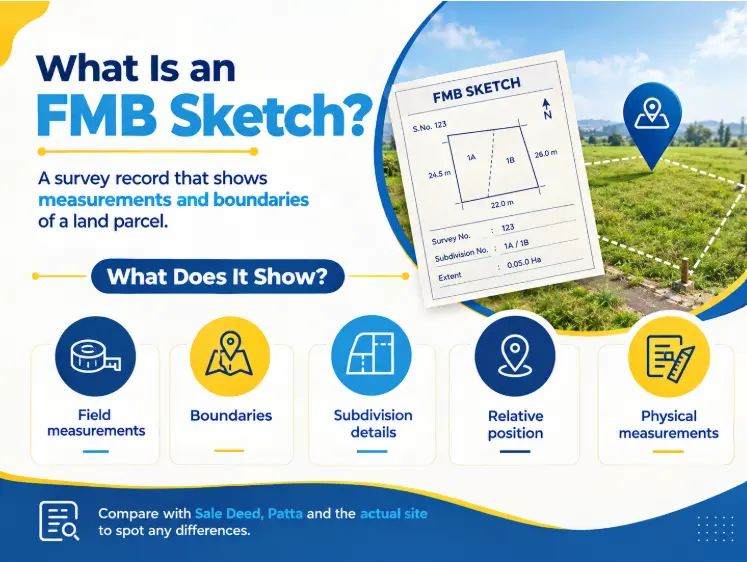
An FMB (Field Measurement Book) Sketch is a survey record that helps identify and measure a land parcel. It shows important physical details such as survey field measurements, boundaries, subdivision details, and the relative position of the survey field. For a buyer, the FMB provides a useful reference when comparing property documents with the land available on site. property documents Tamil Nadu You can compare the FMB with the Sale Deed, Patta, and actual property boundaries to identify differences in measurements or location. property documents Tamil Nadu The FMB does not replace title documents. Instead, it supports property verification by showing the survey-related physical details of the land you plan to purchase.
What Is an FMB Sketch?
FMB stands for Field Measurement Book. It records survey measurements and physical details that help identify a particular survey field. property documents Tamil Nadu The record can include the field’s measurements, boundaries, subdivision details, and relative position. These details help buyers connect the property described in documents with the land they see on the ground.
When checking an FMB, compare it with:
- Sale Deed — property description and extent
- Patta — survey and land details
- FMB — survey measurements and boundaries
- Physical site — actual boundaries and dimensions
The FMB works as a measurement reference rather than an ownership document. A buyer should therefore use it alongside title, revenue, and registration records. This document-by-document comparison can help identify inconsistencies before completing a land purchase.
What Does an FMB Sketch Show?
An FMB Sketch focuses on the physical and survey-related details of a land parcel. property documents Tamil Nadu It helps you understand how the survey field sits within the surrounding area and how its measurements relate to the property documents.
| FMB Detail | What It Helps You Check |
| Field measurements | Dimensions of the survey field |
| Boundaries | Location of the property’s limits |
| Subdivision details | Divided portions of a survey field |
| Relative position | Position of the survey field in relation to surrounding areas |
| Physical measurements | Survey-based dimensions for comparison |
For example, if the Sale Deed describes a specific extent but the FMB measurements suggest a different configuration, investigate the difference. You can then compare the FMB with Patta and the physical property before moving forward. The FMB supports verification, but it does not establish ownership by itself.
Why Is FMB Important When Buying Land?
FMB becomes useful when you need to confirm whether the land shown by the seller matches the survey information in the documents. It gives you a reference for comparing the Sale Deed → Patta → FMB → Physical Property. Your blog outline specifically recommends this comparison because it helps determine whether the property on paper corresponds with the land shown on site.
Example: A seller shows you a 2,400 sq. ft. plot. The Sale Deed states 2,400 sq. ft., but the site’s boundaries do not appear to match the survey measurements. Check the FMB before proceeding.
Also compare:
- Survey number
- Subdivision details
- Measurements
- Boundaries
- Physical location
If these details do not match, pause the transaction and seek professional verification before paying a substantial amount.
Conclusion
When buying land in Tamil Nadu, no single document tells the complete story. The Sale Deed records the property transaction and title history, Patta provides revenue-related details, EC helps identify registered transactions or encumbrances within the search period, and FMB helps verify survey measurements and boundaries.
The safest approach is to compare all these records with the actual property on the ground. If you find mismatched names, survey numbers, boundaries, extent, missing parent documents, or unclear transactions, do not ignore them. Before you buy, verify the complete property document chain and seek professional legal advice when needed. A few careful checks today can help you avoid costly property disputes later.
FAQ’s
1. Does a Sale Deed prove property ownership?
A Sale Deed records the registered property transaction and forms an important part of the title documents.
2. Does Patta prove ownership?
Patta is a revenue record and should be checked along with the Sale Deed and other supporting documents.
3. What does an EC show?
An EC shows registered transactions or encumbrances covered within the selected search period.
4. What is an FMB Sketch?
An FMB Sketch records survey measurements, boundaries, and other physical details of the land parcel.
5. Is an EC enough to verify a property?
No. Buyers should also check the title chain, Patta, FMB, and other relevant property records.
6. Why should buyers check the latest Patta?
The latest Patta helps buyers verify the recorded revenue details and the name associated with the property.
7. Why should I compare the FMB with the actual land?
Comparing them helps identify differences in measurements, boundaries, survey details, or physical extent.
8. What documents should I check before buying land?
Check the Sale Deed, parent documents, Patta, EC, FMB, approvals, and other relevant property records.
9. What if the Sale Deed and Patta have different names?
A name mismatch needs careful verification before proceeding with the property transaction.
10. Should I consult a property lawyer before buying land?
Professional legal advice can help when you find unclear title, missing documents, ownership issues, or record mismatches.