Enquire Now for a free site visit – call
Introduction
Buying property without checking its ownership history can leave buyers exposed to document gaps, disputed titles, or inconsistent property details. A parent document helps trace how ownership has passed from one owner to another and provides an important link in the property’s title history. This matters in an increasingly Digital India Land Records Modernization Program India’s Department of Land Resources reported that 98.5% of available rural Record of Rights had been digitized at the national level, while Tamil Nadu was among the states reporting 99%+ computerization in the 2024 data. But digital availability does not replace careful verification. parent document property In this guide, learn what a parent document is, how to trace previous ownership, which records to cross-check, and what warning signs to look for before purchasing property.
What Is a Parent Document in Property?
A parent document in property is an earlier legal document that helps trace how a property services moved from one owner to another. It forms an important part of the property’s ownership chain and helps buyers compare the current title with previous transactions. Checking this history can reveal gaps, mismatched details, or unclear transfers before a purchase. parent document property India’s Department of Land Resources reported that 95.09% of villages had computerized Records of Rights as of December 31, 2023, while Tamil Nadu had reached 99% or more. Still, digital records do not replace document-level verification. Parent document property A careful buyer should review the parent document alongside the current sale deed, registration details, and relevant land records.
Parent Document Meaning
In simple terms, a parent document refers to an earlier document that establishes a property’s previous ownership or title history. It connects the current owner’s document with earlier owners and transactions. Parent document property: Depending on the property’s history, it may include an earlier sale deed, partition deed, gift deed, settlement deed, or another relevant title document
When checking a parent document, compare:
- Owner names
- Survey and subdivision numbers
- Property extent
- Boundaries
- Registration details
- Transaction dates
Why Is It Called a Parent Document?
The term “parent document” makes sense when you look at a property’s ownership chain. parent document property Think of the current sale deed as one link and the earlier document as the link that explains where that ownership came from.
For example, if Priya buys land from Arun, Priya’s sale deed records her purchase. Arun’s earlier registered document can act as the parent document that helps trace his ownership.
It can help you:
- Trace previous owners.
- Understand earlier property transfers.
- Compare property descriptions.
- Identify gaps in the ownership chain.
- Cross-check survey numbers and boundaries.
- Understand how the current title developed.
Government land-record modernization also focuses on connecting registration data with land records. parent document property As of December 2023, computerization of registration exceeded 93% across 29 States/UTs, according to the Department of Land Resources.
Parent Document vs Current Sale Deed
A parent document and a current sale deed serve different purposes. The parent document helps explain an earlier stage of ownership, while the current sale deed records the latest transfer between the seller and buyer.
Example:
Imagine Arun purchased a plot from Bala in 2018. Arun then sells the same plot to Divya in 2026.
- Bala → Arun: The 2018 sale deed forms part of the property’s previous ownership history.
- Arun → Divya: The 2026 sale deed records the current transfer.
Divya should compare both documents to check whether important details remain consistent.
| Parent Document | Current Sale Deed |
| Shows earlier ownership | Records current transfer |
| Helps trace title history | Establishes the latest transaction |
| Contains previous transaction details | Contains buyer and seller details |
| Supports ownership-chain verification | Records the new sale |
Why Is a Parent Document Important for Property Buyers?
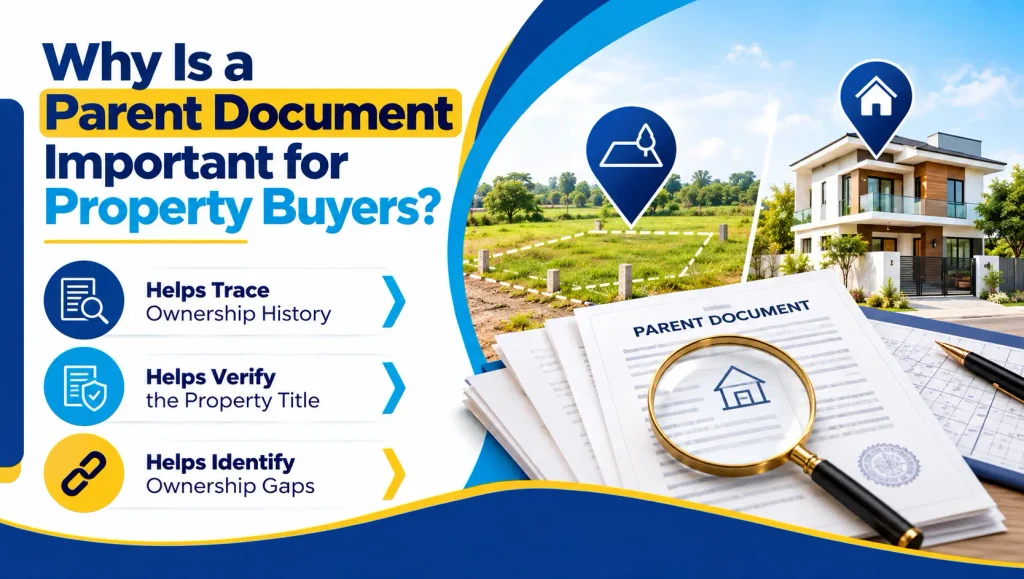
A parent document gives buyers a clearer picture of how a property reached its current owner. It helps connect previous transactions with the latest sale deed and allows buyers to compare names, survey numbers, boundaries, and property extent. parent document property This matters because India has significantly expanded digital land-record systems. parent document property The Department of Land Resources reported that 97.27% of villages had computerized Records of Rights by the end of 2025, while 97.14% had digitized cadastral maps. However, digital records do not remove the need for document verification. By reviewing the parent document alongside, registration and land-record systems buyers can spot inconsistencies earlier and make a more informed property decision.
Helps Trace Ownership History
A property rarely starts with its current owner. Previous owners, sales, gifts, partitions, or settlements may form a chain of transactions. parent document property A parent document helps buyers follow that chain and understand how ownership moved over time.
For example, imagine Ravi wants to buy land from Kumar. Kumar’s current sale deed shows that he owns the property, but Ravi can also review Kumar’s earlier purchase document to understand how Kumar acquired it.
During the review, compare:
- Previous and current owner names
- Survey and subdivision numbers
- Property measurements
- Boundaries
- Registration numbers and dates
- Nature of each transaction
The Department of Land Resources says its land-record modernization program aims to improve transparency, reduce disputes, and check fraudulent transactions.
Helps Verify the Property Title
A parent document supports the process of checking whether the seller’s claimed ownership connects with earlier property records. Parent document property: Buyers should compare the parent document with the current sale deed and relevant land or registration records rather than relying on one document alone.
| What to Check | Why It Matters |
| Owner’s name | Confirms continuity between transactions |
| Survey number | Helps identify the same land parcel |
| Property extent | Helps detect area differences |
| Boundaries | Supports property identification |
| Registration details | Helps verify the transaction record |
India’s DILRMP had computerized 97.27% of village Records of Rights by the end of 2025, supporting wider access to land information. Still, buyers should treat digital records as part of a broader verification process. parent document property A qualified property professional can review the title chain when the transaction involves complex ownership history.
Helps Identify Ownership Gaps
A parent document can help buyers notice missing links in a property’s ownership history. parent document property A gap may appear when the current owner’s document refers to an earlier owner, but the supporting document for that earlier transfer does not appear in the records provided.
Example:
Suppose Arun sells land to Priya in 2025. Priya shows her sale deed, but that deed states that Arun acquired the property from Kumar. parent document property If Arun cannot provide the relevant earlier document, the buyer should investigate the missing link before proceeding.
Look for:
- Missing previous sale deeds
- Different owner names
- Mismatched survey numbers
- Changes in property extent
- Boundary differences
- Unexplained transfers
The Department of Land Resources reports that land-record modernization aims to reduce land disputes and improve transparency. A missing document does not automatically mean a property has a problem, but it gives the buyer a reason to investigate the ownership chain carefully.
Types of Parent Documents Used in Property Transactions
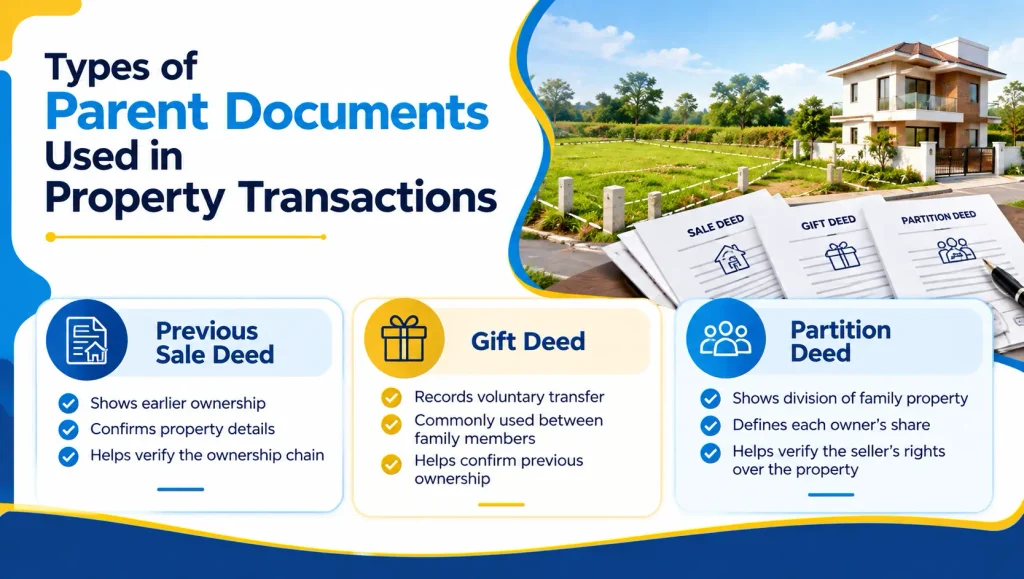
Property ownership can change through sales, gifts, family partitions, settlements, and other legal transfers. Each transaction can create a document that helps explain the property’s ownership history. The right parent document depends on how the previous owner acquired the property. Parent document property For example, a previous sale may point to a sale deed, while inherited or family-divided property may involve different documents. parent document property India’s Department of Land Resources reports that registration computerization has crossed 93% in 29 States/UTs, supporting wider digital access to registration information. Buyers should still compare the relevant parent document with current title records and other supporting documents.
Previous Sale Deed
A previous sale deed records an earlier sale of the property from one owner to another. parent document property It often forms an important link in the ownership chain when the current seller acquired the property through a previous purchase.
For example, Kumar bought a plot from Ravi in 2018 and now plans to sell it to Priya in 2026. Kumar’s 2018 sale deed can help Priya understand how Kumar obtained ownership.
When reviewing a previous sale deed, check:
- Names of the previous buyer and seller
- Survey and subdivision numbers
- Property extent
- Boundaries
- Registration number and date
- Sale consideration and transaction details
The Department of Land Resources includes computerization of registration and integration between registration offices and land records among DILRMP’s major activities. parent document property These records can support a broader ownership-history check.
Gift Deed
A gift deed records a voluntary transfer of property without a conventional sale transaction. Family document property Families commonly use gift deeds when transferring property between relatives, although the legal requirements depend on the circumstances and applicable law.
If a seller received the property through a gift, the buyer should examine that gift deed as part of the ownership history.
Important details to check include:
- Donor and recipient names
- Property description
- Survey number and extent
- Registration details
- Date of transfer
- Relevant conditions in the document
Partition Deed
A partition deed helps explain how jointly owned property gets divided among family members or co-owners. Parent document property It can become an important part of the ownership chain when a seller receives a specific portion of a larger property through partition.
Example: Suppose three siblings jointly own 3 acres. A partition divides the land into separate portions, and each sibling receives a defined share. If one sibling later sells their portion, the buyer should review the partition deed to understand the seller’s rights over that specific property.
Check:
- Names of all parties
- Share allocated to each person
- Survey and subdivision numbers
- Property measurements
- Boundaries
- Registration details
- Description of the divided portions
The Department of Land Resources says its land-record modernization program aims to improve transparency and reduce land disputes. parent document property A partition document, along with relevant land and registration records, can help buyers understand the property’s ownership trail.
How to Check Property Ownership History Using Parent Documents
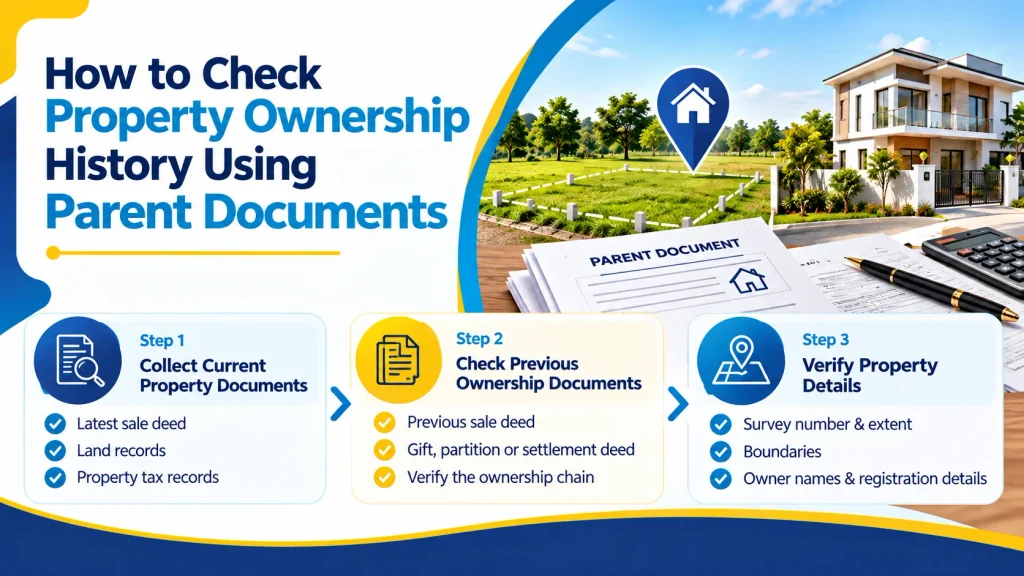
Checking property ownership history means following the document trail from the current owner to earlier owners. Start with the latest property documents, collect previous ownership records, and compare key details across every document. Pay close attention to names, survey numbers, property extent, boundaries, registration numbers, and transaction dates. Parent document property India has made major progress in digital land records: the Department of Land Resources reported 99.90% computerization of Records of Rights and 98.96% computerization of Sub-Registrar Offices in its latest reported figures. Digital records can make verification easier, but buyers should still compare official records with the actual documents and seek professional legal advice when the ownership history looks complex.
Step 1 – Collect the Current Property Documents
Begin with the documents that show the current owner’s claim over the property. Ask the seller for the latest sale deed or other relevant title document and check whether the details match the property you plan to purchase.
Create a basic document file containing:
- Current sale deed
- Latest title-related documents
- Encumbrance Certificate, where applicable
- Relevant land or revenue records
- Property tax records
- Approved plans or layout documents, where applicable
Check the seller’s name, survey number, subdivision number, property extent, boundaries, and registration details. parent document property Do not rely only on photocopies or screenshots when official records are available.
Step 2 – Ask for Previous Ownership Documents
After collecting the current documents, ask the seller to provide the earlier documents that explain how they acquired the property. These documents create the ownership chain and help you understand previous transfers.
| Document | What to Check |
| Previous Sale Deed | Previous buyer and seller |
| Gift Deed | Donor and recipient |
| Partition Deed | Shares and divided property |
| Settlement Deed | Transfer details |
| Release Deed | Released ownership rights |
| Inheritance Documents | Succession and legal heirs |
Compare every document with the current title and look for consistent property details.parent document property The Department of Land Resources reported that 88.6% of Sub-Registrar Offices were integrated with revenue offices in its 2025 review, supporting greater connectivity between registration and land records.
Step 3 – Verify Property Details
Once you collect the documents, compare the property’s identifying details across the entire ownership chain. Parent document property Small differences can create confusion, so check each document carefully instead of focusing only on the owner’s name.
Pay particular attention to:
- Survey number and subdivision number
- Property extent
- Four boundaries
- Plot or door number
- Village, taluk, and district
- Registration number and date
- Previous and current owner names
Example: Suppose a current sale deed describes a property as 2,400 sq. ft., but an earlier document mentions 2,000 sq. ft. Do not ignore the difference. Ask for supporting records and understand why the measurement changed.
Digital records can help with this comparison. parent document property The Department of Land Resources reported 97.14% digitization of cadastral maps nationwide in its 2025 year-end review. Use the available official records alongside the parent documents to check whether the property details consistently describe the same parcel.
Conclusion
Understanding a parent document can make property ownership verification much clearer and help buyers trace how a property moved from one owner to another. Reviewing previous sale deeds, gift deeds, partition deeds, and other relevant records allows you to compare ownership details, survey numbers, property extent, and boundaries across the title history. Don’t rely only on the latest sale deed or online records. Check the complete document chain and investigate any missing or inconsistent information before proceeding with a purchase.
Planning to buy land or property? Take time to verify the ownership history and supporting documents, and consult a qualified property professional when necessary. A careful document check today can help you make a more informed property decision tomorrow.
FAQ’s
1. What is a parent document in property?
A parent document is an earlier property document that helps trace previous ownership.It forms an important link in the property’s ownership history.
2. Why is a parent document important?
It helps buyers verify the ownership chain and compare previous property details.It can also highlight missing or inconsistent information.
3. Is a parent document the same as a sale deed?
No, a parent document usually refers to an earlier ownership document.A sale deed records a specific transfer of property between parties.
4. How can I find a property’s parent document?
Ask the seller for previous ownership documents and check relevant registration records.You can also seek help from a qualified property professional.
5. What details should I check in a parent document?
Check owner names, survey numbers, property extent, boundaries, and registration details. Compare these details with the current property documents.
6. Can a gift deed become a parent document?
Yes, a gift deed can form part of the property’s ownership history.
It can explain how a previous owner acquired the property.
7. Can a partition deed be a parent document?
Yes, a partition deed can establish how jointly owned property was divided.It can help confirm the seller’s share and property boundaries.
8. What if there is a gap in the ownership documents?
A missing document does not automatically mean the property has a legal issue.However, investigate the gap carefully before proceeding with the purchase.
9. Should I check the Encumbrance Certificate too?
Yes, an Encumbrance Certificate can provide information about registered transactions and encumbrances.
Use it alongside the parent document and other relevant property records.
10. Should I consult a property lawyer?
Yes, professional title verification can help identify complex ownership or documentation issues.This becomes especially useful when the property’s history contains multiple transfers.