Enquire Now for a free site visit – call


Introduction:
Buying a plot in Tamil Nadu involves more than checking the location, price, and road access. OSR land OSR land Tamil Nadu. One overlooked detail in an approved layout can significantly affect what land you can actually use: OSR (Open Space Reservation) land. So, what exactly is OSR land, and how does it affect plot buyers? Under the Tamil Nadu Combined Development and Building Rules, layouts above 10,000 sq. m. are required to reserve 10% of the area, excluding roads, for recreational purposes. OSR land Tamil Nadu The rules also state that this reserved land is to remain free from construction by the layout owner or developer. Understanding OSR markings, approved layout plans, and property documents can help buyers distinguish a saleable residential plot from reserved open space before making a purchase.
What Does OSR Mean in Real Estate?
OSR stands for Open Space Reservation, a designated portion of land kept for community recreational purposes within certain layouts. In Tamil Nadu, the Combined Development and Building Rules specify recreational-space requirements based on the total layout area. For layouts above 10,000 sq. m., the rules require 10% of the area, excluding roads, for recreational purposes.
For plot buyers, OSR matters because not every open or vacant portion of a layout qualifies as a saleable residential plot. An approved layout plan clearly identifies reserved areas, roads, and individual plots. Checking these details before purchase helps you understand exactly what land you can legally develop and prevents confusion between a residential plot and reserved open space.
OSR Full Form
OSR stands for Open Space Reservation. In real estate, it refers to land reserved within a layout for community recreational purposes, such as open spaces and recreational facilities.Tamil Nadu’s development rules include specific requirements for recreational-space reservation depending on the size of the layout.
For example, the rules provide these thresholds:
- Up to 3,000 sq. m.: No OSR reservation under the specified table.
- 3,000–10,000 sq. m.: 10% reservation, excluding roads, subject to the applicable provisions.
- Above 10,000 sq. m.: 10% reservation, excluding roads, becomes obligatory.
So, when you see “OSR” on a layout plan, don’t treat it as another residential plot. Check the approved plan to understand its exact purpose and location.
Why Is OSR Provided in Layouts?
OSR helps layouts retain dedicated space for community recreation and open-space purposes instead of using every portion of land for plots, buildings, and roads.
OSR land in Tamil Nadu is subject to recreational-space reservation requirements based on layout size. For developments above 10,000 sq. m., 10% of the area excluding roads must be reserved for recreational purposes. For plot buyers, OSR can help create a more clearly planned layout by providing space intended for community use.
Key reasons include:
- Community recreation: Provides space for recreational purposes.
- Planned layouts: Separates recreational areas from saleable plots and roads.
- Open-space provision: Prevents the entire layout from becoming built-up land.
- Community use: The rules allow limited supporting structures in the reserved area under specified conditions.
Always check the approved layout plan to confirm how the OSR area appears and what rules apply to it.
Is OSR the Same as a Road or Setback?
No. OSR, road area, and setback serve different purposes.
OSR refers to land reserved for recreational purposes. A road provides access and movement through the layout, while a setback creates the required open distance around a building or plot according to applicable building rules. Tamil Nadu’s OSR provisions specifically calculate recreational reservation excluding roads, which shows that the two categories are separate.
For example, imagine a layout containing:
- Residential plot: 1,200 sq. ft. designated for individual development.
- Road: Provides access to that plot.
- OSR area: Reserved for community recreational purposes.
- Setback: Open space required around a building within the applicable plot.
So, seeing a large vacant area does not automatically mean you can purchase or construct on it. Check the approved layout and relevant planning approval before treating any open area as a residential plot.
What Are the OSR Rules in Tamil Nadu?
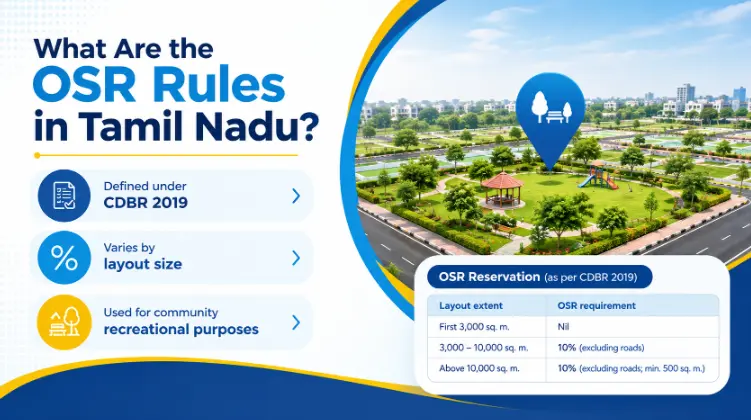
Tamil Nadu’s Combined Development and Building Rules (CDBR) 2019 set specific requirements for recreational open space in layouts. The rules divide OSR requirements according to layout size. For the first 3,000 sq. m., the specified reservation is nil. For layouts between 3,000 and 10,000 sq. m., the rules specify 10% of the area excluding roads, subject to minimum-size conditions.
For layouts above 10,000 sq. m., developers must reserve 10% excluding roads, with a minimum reserved area of 500 sq. m. For plot buyers, these figures matter because the approved layout should clearly distinguish residential plots, roads, and recreational reservation areas.
OSR Reservation Requirements
Tamil Nadu’s CDBR 2019 specifies OSR requirements based on the total layout area. The rules focus on community recreational purposes, such as parks and playgrounds.
| Layout Extent | OSR Requirement |
|---|---|
| First 3,000 sq. m. | Nil |
| 3,000–10,000 sq. m. | 10% excluding roads |
| Above 10,000 sq. m. | 10% excluding roads; minimum 500 sq. m. |
For the 3,000–10,000 sq. m. category, the reserved area must measure at least 100 sq. m. with a minimum width of 10 meters. For developments above 10,000 sq. m., the rules require the reservation and handover of the space for new developments or redevelopments.
What Can OSR Land Be Used For?
OSR land primarily supports community recreational purposes. The rules specify that the reserved land should remain at ground level and remain free from construction by the layout owner or developer.
| OSR Use | What the Rules Indicate |
|---|---|
| Park | Permitted recreational purpose |
| Playground | Permitted recreational purpose |
| Watchman’s booth | May be permitted for maintenance |
| Gardener’s instrument room | May be permitted |
| Public toilet | May be permitted |
| Police booth | May be permitted |
| Basement parking | May be permitted subject to the rules |
| Rainwater-harvesting tanks/STP | May be permitted below OSR |
The rules limit the combined floor area of specified maintenance structures to 5% of the total OSR area in one place. This means buyers should not assume that OSR land works like an ordinary residential plot.
Can Buildings Be Constructed on OSR Land?
Generally, buyers should not treat OSR land as a normal buildable residential plot. Tamil Nadu’s CDBR 2019 states that land reserved for community recreational purposes should remain at ground level and remain free from construction by the layout owner or developer.
The rules do allow limited structures for specific purposes. For example:
- A watchman’s booth may support security and maintenance.
- A gardener’s instrument room may support park maintenance.
- A public toilet or police booth may serve community needs.
- Certain parking, rainwater-harvesting, and STP facilities may occur below the OSR subject to applicable rules.
For example, if a layout marks 5,000 sq. m. as OSR, a buyer should not assume that the vacant land can become an additional house plot.
Always compare the approved layout plan with the actual site before making a purchase.
Can You Buy OSR Land as a Residential Plot?
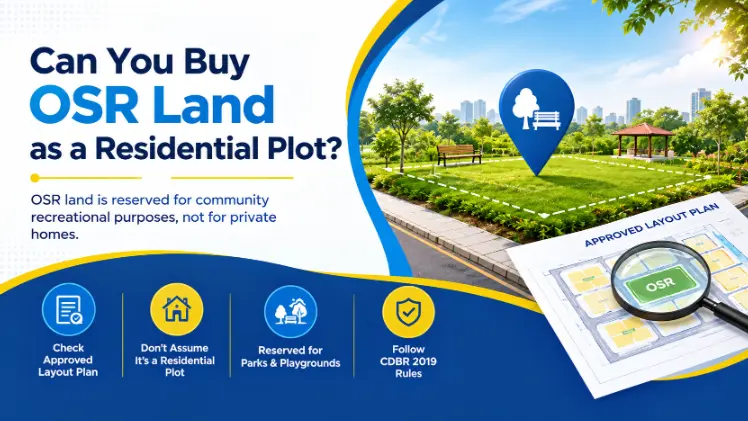
OSR land should not be treated as an ordinary residential plot. Tamil Nadu’s CDBR 2019 identifies OSR as land reserved for community recreational purposes, such as parks or playgrounds. For layouts above 10,000 sq. m., the rules require 10% of the area excluding roads, with the reserved space measuring at least 500 sq. m.
Before purchasing any plot, compare the seller’s documents with the approved layout plan. Check whether the plot number, boundaries, survey details, and land-use designation match the approval. If a vacant area appears attractive but the plan identifies it as OSR, do not assume it qualifies as a residential plot. Verify the applicable approval and legal records before proceeding.
Can You Build a House on OSR Land?
You generally cannot treat OSR land like a normal residential plot and construct a private house on it. Tamil Nadu’s rules state that land reserved for community recreational purposes should remain at ground level and free from construction by the layout owner or developer.
The rules allow only certain limited facilities, subject to the applicable conditions:
- Watchman’s booth
- Gardener’s instrument room
- Public toilet
- Police booth
- Certain basement parking facilities
- Rainwater-harvesting tanks and STP below the OSR
For example, if an approved layout marks 500 sq. m. as OSR, a buyer should not assume that the area can accommodate a private residence. The approved layout and applicable planning conditions determine how that space can function. Always verify the plan before considering construction.
Exclusive and Distraction-Free Environment
OSR does not mean that a residential plot automatically gets a private recreational space. Instead, OSR creates a designated community recreational area within applicable layouts.
The Tamil Nadu rules require this reserved space to remain at ground level and specify its shape and location through the competent authority.
For residents, a properly planned open area can support:
- Recreational space: Suitable for community-oriented activities.
- Open surroundings: Keeps designated land separate from regular residential plots.
- Planned development: Clearly separates recreational areas from roads and saleable plots.
- Community use: In residential developments, the local body may permit a Residents Association or Flat Owner’s Association to maintain the reserved space as a park or playground.
However, buyers should not interpret OSR as an individually owned garden or private amenity unless the approved documents specifically establish that arrangement.
What Happens When OSR Is Shown in a Layout Plan?
When an approved layout plan marks an area as OSR, it identifies that portion for community recreational purposes. The OSR area remains separate from regular residential plots and roads. For layouts above 10,000 sq. m., the rules require 10% of the area excluding roads, with at least 500 sq. m. reserved.
Example: Imagine a layout covering 12,000 sq. m., excluding roads for the calculation. The applicable 10% requirement would mean 1,200 sq. m. for recreational reservation, subject to the detailed rules and approval.
A buyer should therefore:
- Locate the OSR marking on the approved plan.
- Check its boundaries and dimensions.
- Confirm that the purchased plot sits outside the reserved area.
- Compare the plan with the physical site.
This simple comparison can help prevent confusion between a residential plot and designated OSR land.
How OSR Affects Plot Buyers

OSR matters because it helps you understand which parts of a layout you can purchase and develop and which areas serve community recreational purposes. Tamil Nadu’s CDBR 2019 requires 10% of the area excluding roads for recreational reservation in layouts above 10,000 sq. m., subject to the detailed rules.
For buyers, this means you should never judge a plot only by its location or the vacant land visible on site. Check the approved layout before paying an advance. Look for the plot number, dimensions, road access, boundaries, and OSR marking. A clear document check can help you understand the exact status of the land you plan to purchase.
Check Whether Your Plot Is Actually a Saleable Plot
Before buying a plot, confirm that the area appears as an individual residential plot in the approved layout, rather than as OSR or another reserved area. The Tamil Nadu rules distinguish recreational reservation from roads and individual development areas.
Use this simple checklist:
- Check the approved layout plan: Find your exact plot number.
- Compare dimensions: Match the plan with the measurements shown by the seller.
- Check the OSR marking: Make sure your plot does not overlap the reserved recreational area.
- Verify road access: Confirm the plot connects to the approved road network.
- Check survey details: Match survey and subdivision details across documents.
- Review approvals: Confirm the applicable planning authority’s approval.
For example, if a seller shows a vacant 2,400 sq. ft. area as a “plot,” but the approved plan marks that portion as OSR, treat the documents—not the vacant appearance—as the key reference.
Verify the Plot’s Exact Boundaries
Exact boundaries matter because a plot can look different on the ground from how it appears on the approved plan. Before purchasing, compare the plot dimensions, survey details, road position, and adjoining plots with the approved documents.
| What to Check | Why It Matters |
|---|---|
| Plot number | Identifies the specific plot |
| Length and width | Confirms the approved dimensions |
| Survey/subdivision details | Connects the plot to land records |
| Four boundaries | Helps match the document with the site |
| Road access | Confirms the approved approach |
| OSR location | Helps ensure the plot does not overlap reserved space |
For example, if the plan shows a 40 × 60 ft plot, but the site measurement differs significantly, ask for clarification before proceeding. Also compare the physical location of nearby roads and OSR areas with the approved plan. This step helps you identify discrepancies early rather than after purchase.
Understand the Difference Between a Plot and Reserved Open Space
A residential plot and OSR area serve different purposes. A residential plot forms part of the individual plots shown in an approved layout, while OSR refers to land reserved for community recreational purposes under the applicable development rules.
For layouts above 10,000 sq. m., Tamil Nadu’s rules require 10% of the area excluding roads for recreational purposes.
Consider two examples:
Example 1: Plot No. 15 measures 40 × 60 ft and appears as a residential plot in the approved plan. You can evaluate it for residential development subject to applicable approvals.
Example 2: A vacant area beside Plot No. 15 appears spacious, but the plan identifies it as OSR. You should not treat that space as another residential plot.
Always use the approved layout to distinguish saleable plots, roads, and reserved open spaces.
Conclusion
Understanding OSR (Open Space Reservation) is an important part of making an informed plot purchase in Tamil Nadu. OSR land serves community recreational purposes and differs from residential plots, roads, and setbacks. Tamil Nadu’s development rules also specify recreational-space requirements based on layout size, including 10% of the area excluding roads for layouts above 10,000 sq. m.
Before you buy, don’t rely only on brochures, site visits, or verbal assurances. Check the approved layout plan, plot boundaries, survey details, road access, ownership documents, and OSR markings. When the documents and physical site match, you can understand exactly what you are purchasing.
Looking for residential plots? Explore approved plot options, verify the documents, and choose a property that matches your requirements.
FAQ’s
1. What is OSR land in Tamil Nadu?
OSR means Open Space Reservation, mainly meant for community recreational purposes.
2. What is the full form of OSR?
OSR stands for Open Space Reservation, as mentioned in Tamil Nadu development rules.
3. Can I build a house on OSR land?
OSR land is not meant for normal residential construction and has specific permitted uses.
4. Can OSR land be sold as a residential plot?
Buyers should verify the approved layout before treating any OSR-marked land as a saleable plot.
5. How much OSR is required in a layout?
The required OSR depends on the total layout area and applicable development rules.
6. Is OSR land the same as a setback?
No. OSR is reserved for recreational purposes, while setbacks are required open spaces around buildings.
7. How can I identify OSR in a layout?
Check the approved layout plan for areas specifically marked as OSR or recreational reservation.
8. Who maintains OSR land?
The applicable authority and approved layout arrangements determine how the reserved area is handled.
9. What documents should I check before buying a plot?
Check the approved layout, title documents, survey details, boundaries, approvals, and land-use information.
10. Why should plot buyers check OSR details?
Checking OSR helps buyers distinguish a residential plot from reserved open space before purchase.