Enquire Now for a free site visit – call

Introduction
Buying a plot is not just about finding the right location or checking the price per square foot—the shape of the land can also influence how effectively you can use it. A square plot may simplify planning, while a rectangular plot can offer practical frontage and depth. An irregular plot, meanwhile, may require more creative design and careful assessment. Best plot shape for house In Tamil Nadu, plot buyers also need to look beyond appearance: government building-approval requirements can involve documents such as the Sale Deed, Patta, FMB, Chitta, Adan gal and Encumbrance Certificate. With digitally accessible land records, including FMB and Patta details, available through Tamil Nadu’s land-record initiatives, buyers have more tools to verify a property before committing. So, Square vs Rectangular vs Irregular Plot: Which Is Better? The answer depends on your construction plans, access, dimensions and long-term goals.
Square vs Rectangular vs Irregular Plot: What Do These Shapes Mean?
When you compare plots, the shape tells you how the land distributes its length and width. best plot shape for house A square plot has four equal sides, while a rectangular plot has two longer and two shorter sides. An irregular plot has unequal or angled boundaries. This difference can affect house planning, parking, open space and construction layout. In Tamil Nadu, building rules also consider site dimensions, setbacks and road width when assessing development proposals. Therefore, buyers should not judge a plot only by its total square feet. Check the actual dimensions, road frontage, access and buildable area before deciding which shape suits your plans.
What Is a Square Plot?
A square plot has four equal sides, giving the land a balanced shape. For example, a 40 × 40 ft plot covers 1,600 sq. ft. A square plot has four equal sides, giving the land a balanced shape. For example, a 40 × 40 ft plot covers 1,600 sq. ft. best plot shape for house This balanced geometry can make it easier to organise rooms, parking and open spaces without dealing with unusual corners. However, a square shape does not automatically mean maximum usable space. Setbacks, road position and building requirements can change the actual construction area. Tamil Nadu’s building rules require site plans to show plot dimensions and setbacks, highlighting why buyers should examine the complete site rather than area alone.
This balanced geometry can make it easier to organise rooms, parking and open spaces without dealing with unusual corners. However, a square shape does not automatically mean maximum usable space. Setbacks, road position and building requirements can change the actual construction area. best plot shape for house Tamil Nadu’s building rules require site plans to show plot dimensions and setbacks, highlighting why buyers should examine the complete site rather than area alone.
A square plot can suit buyers who want:
- A relatively straightforward floor-plan layout
- Balanced front and rear spaces
- Flexible room positioning
- Simpler initial planning
Before buying, compare the square plot’s frontage, access and permissible building area with your intended house design.
What Is a Rectangular Plot?
A rectangular plot has two longer sides and two shorter sides. best plot shape for houseFor example, a 30 × 50 ft plot also provides 1,500 sq. ft., but its proportions differ significantly from a 38.7 × 38.7 ft square plot of roughly the same area. That difference can change how you arrange bedrooms, living areas, parking and gardens. A rectangular plot often works well when you want to divide the property into clear front, middle and rear zones.
Key factors to check include:
- Frontage: Determines the available width for entrances and parking.
- Depth: Influences how you arrange rooms and open spaces.
- Road access: Affects entry and exit planning.
- Setbacks: Reduce the usable construction footprint.
Tamil Nadu rules also require building plans to show plot dimensions and setbacks.
What Is an Irregular Plot?
irregular plot has unequal sides, angled boundaries, curves or An unusual corners rather than a simple square or rectangle. For example, imagine a 30-ft frontage that expands to 42 ft at the rear, or a plot with one diagonal boundary. The total area may look attractive on paper, but the unusual shape can influence parking, room placement and open-space planning.
For example:
- A triangular corner plot may create an unusual entrance layout.
- A wedge-shaped plot may leave difficult-to-use corners.
- A plot with unequal frontage may require customised parking and access planning.
Irregular plots do not automatically make poor investments. best plot shape for house A strong location, wider road frontage or favourable access can offset planning challenges. Best plot shape for house However, buyers should ask an architect to test the proposed layout before committing. Tamil Nadu’s rules require site and building plans to show dimensions and relevant setbacks.
What Makes a Plot Shape Good for Construction?
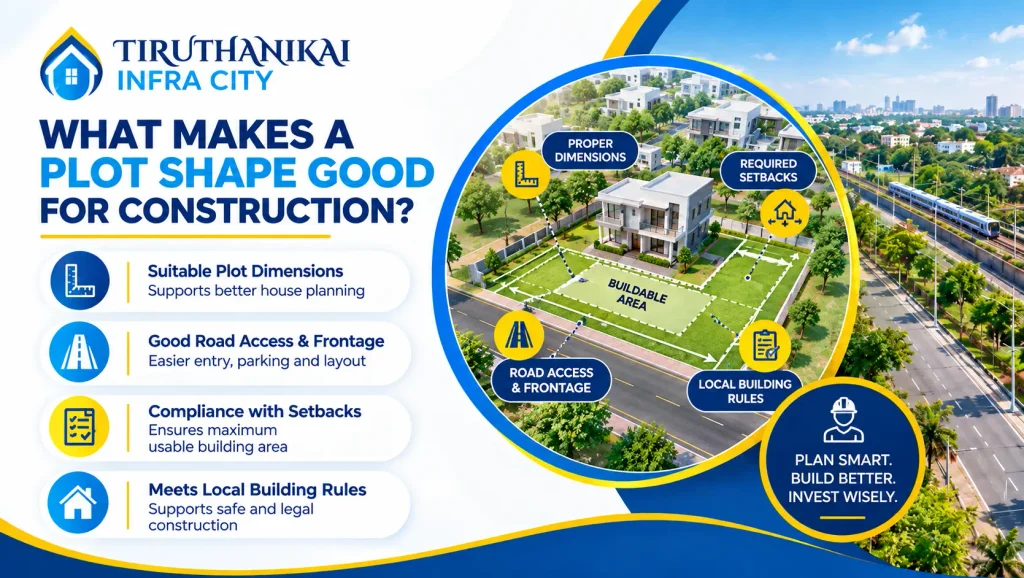
A good plot shape gives you enough usable space to plan the building, parking, open areas and access without creating unnecessary complications. best plot shape for house However, shape alone does not decide construction feasibility. Plot dimensions, road width, frontage, setbacks and permitted development also matter. Tamil Nadu’s Combined Development and Building Rules consider these factors when regulating construction. best plot shape for house For example, the rules specify different setback requirements based on factors such as building height, plot width and road conditions. A practical plot should therefore support your intended floor plan while meeting applicable regulations. Before buying, check the actual measurements and ask an architect to test your proposed layout rather than judging the property by appearance alone.
Road Access and Frontage
Road access and frontage can influence how easily you enter the property, arrange parking and position the main entrance. best plot shape for houseA plot with a good total area may still create planning challenges if it has very narrow frontage or difficult road access. best plot shape for house Tamil Nadu’s building rules uses road width as one of the planning parameters, and certain development categories specify minimum road-width requirements.
| Factor | Why It Matters |
| Frontage | Helps plan entrance and parking |
| Road width | Can affect development permissions |
| Corner access | May provide additional access options |
| Entry position | Influences driveway and floor-plan planning |
For example, a 30 × 50 ft plot with good road access may work differently from another 30 × 50 ft plot on a restricted approach road. Always verify the actual road and access conditions before purchase.
Setbacks and Local Building Rules
A plot may look spacious on paper, but setbacks can reduce the area available for construction. best plot shape for house Tamil Nadu’s Combined Development and Building Rules specify setback requirements that can vary according to factors such as road width, building height and plot conditions.best plot shape for house For example, best plot shape for house the rules include front setbacks of 3.0 m, 4.5 m or 6.0 m for certain non-high-rise development categories depending on the abutting road width.
Consider a simple example: if a plot measures 30 × 50 ft, you cannot assume that the full 1,500 sq. ft. will become your building footprint. Required front, rear and side spaces can change the usable area.
Before buying, check:
- Applicable local building rules
- Required setbacks
- Road width
- Permitted building height
- Buildable area
Advantages and Limitations of a Square Plot

Potential Advantages
A square plot can offer several practical benefits when its dimensions and access suit your building requirements. best plot shape for house Equal sides creates a balanced footprint, which can make initial space planning easier. For example, a 40 × 40 ft plot gives 1,600 sq. ft., allowing you to explore different room arrangements within a compact footprint.
Potential advantages include:
- Balanced dimensions: Similar front and side measurements can simplify planning.
- Flexible layouts: You can experiment with different room positions.
- Simpler circulation: A balanced footprint can reduce awkward corners.
- Easier space zoning: You can divide areas for living, parking and open space.
- Straightforward design: Architects can start with a regular geometric shape.
Potential Limitations
A square plot can look ideal on paper, but its shape alone cannot guarantee efficient construction. Best plot shape for house Setbacks may reduce the buildable footprint, while a narrow road or inconvenient entrance can affect parking and access. For example, a 30 × 30 ft plot provides 900 sq. ft., but the usable building area may become considerably smaller after applying the applicable setbacks and other requirements.
Potential limitations include:
- Limited frontage: A smaller square plot may restrict parking arrangements.
- Setback impact: Required open spaces can reduce the construction footprint.
- Parking challenges: Compact dimensions may limit driveway options.
- Room-size restrictions: Larger rooms may require careful space planning.
- Road-access issues: A convenient shape cannot compensate for difficult access.
When a Square Plot May Work Well
A square plot may work well when you want a relatively balanced layout and your intended building fits comfortably within the available dimensions. Best plot shape for house For example, a 40 × 40 ft plot offers 1,600 sq. ft., giving an architect a regular footprint to work with. A compact independent house could use the space for bedrooms, living areas, parking and a small open area, depending on applicable setbacks and design requirements.
A square plot may suit:
- Compact family homes with straightforward layouts
- Single-floor houses with balanced room arrangements
- Duplex designs where the architect can organise rooms around a regular footprint
- Buyers who value simple planning over highly customised layouts
For example, if two plots have similar prices and one offers a regular shape with suitable frontage and access, the square geometry may simplify the initial design process. Best plot shape for house Still, check the actual buildable area before deciding.
Advantages and Limitations of an Irregular Plot
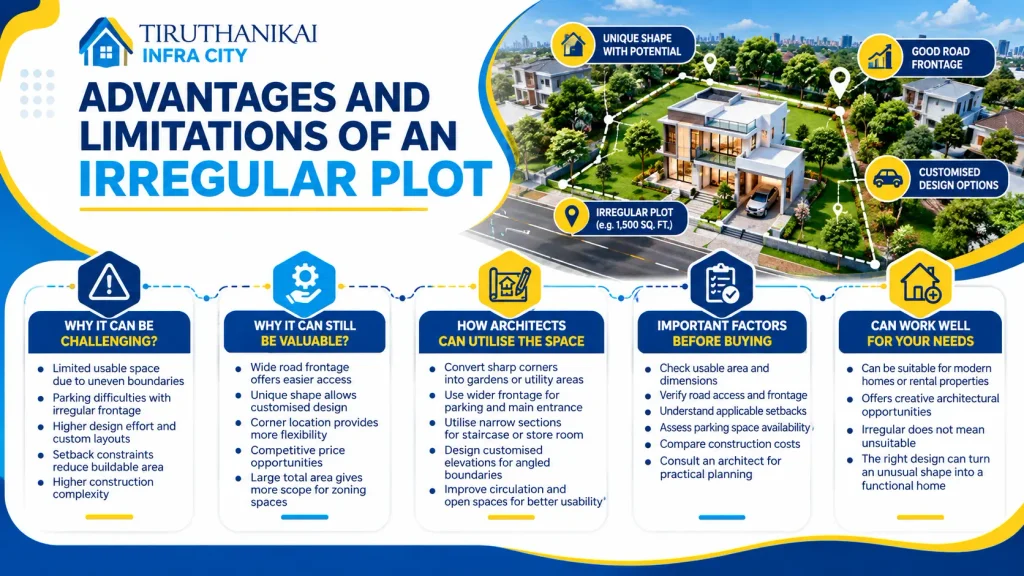
An irregular plot has uneven sides, unusual angles, or a non-standard shape. It can offer unique design opportunities, but it may require more planning than a square or rectangular plot. For example, a 1,500 sq. ft. irregular plot may provide good road frontage while creating unused corners. Buyers should compare the usable area, dimensions, road access, setbacks, parking space, and construction cost rather than focusing only on total square footage. The right design can turn an unusual shape into a functional home. best plot shape for houseHowever, complex layouts may increase architectural work and construction costs. Always assess the plot with a professional before purchasing.
Why Irregular Plots Can Be Challenging
Irregular plots can create practical challenges because their uneven boundaries make planning less straightforward. best plot shape for house A plot may have four or more sides with different lengths, sharp corners, or a narrow section that limits usable space. Best plot shape for house For example, a 30 × 50 ft rectangular plot offers predictable dimensions, while an irregular plot with a similar total area may provide less efficient floor planning.
Common challenges include:
- Limited usable space: Corners and narrow sections may remain difficult to use.
- Parking difficulties: Uneven frontage can make vehicle entry and turning harder.
- Higher design effort: Architects may need custom layouts instead of standard plans.
- Setback constraints: Required open spaces can reduce the buildable portion.
- Higher construction complexity: Unusual angles can require customised structural solutions.
Why an Irregular Plot Can Still Be Valuable
An irregular plot can still offer strong value when its location, road frontage, dimensions, and price match the buyer’s requirements. A unique shape may even create opportunities for creative architectural planning. best plot shape for house For example, a corner plot with an angled boundary could support a distinctive entrance, garden, parking area, or larger frontage.
| Factor | Potential Benefit |
| Wide road frontage | Easier access and better visibility |
| Unique shape | Opportunity for customised design |
| Corner location | More flexibility for entrances |
| Competitive price | Possible value if planning works |
| Large total area | More scope for zoning spaces |
The key point is simple: irregular does not automatically mean unsuitable. If an architect can convert the available area into functional spaces, the plot may work well for a modern home, rental property, or customised building.
How Architects Can Handle Irregular Plots
Architects can turn an irregular plot into a practical layout by studying its dimensions, road access, orientation, setbacks, and buildable area before designing the house. Instead of forcing a rectangular plan onto the land, they can divide the plot into functional zones.
For example:
- A sharp corner can become a landscaped garden or utility area.
- A wider frontage can accommodate parking and the main entrance.
- A narrow rear section can work for a staircase, store room, or service space.
- An angled boundary can inspire a customised elevation or balcony.
Suppose a 1,800 sq. ft. irregular plot has 600 sq. ft. of difficult-to-use corners. An architect can redesign circulation and open spaces to improve practical usability. best plot shape for house Early consultation helps buyers understand construction possibilities before they commit to the property.
Conclusion
There is no single answer to “Square vs Rectangular vs Irregular Plot: Which Is Better?” The right choice depends on your house plan, road frontage, parking needs, usable space, budget, and long-term goals. Square plots can simplify planning, rectangular plots often provide practical depth and frontage, while irregular plots can offer unique design opportunities when planned carefully.
Before buying, look beyond the total square footage. Check the plot dimensions, access, setbacks, documents, surrounding development, and actual buildable area. A professional site assessment can also help you understand the plot’s construction potential before you invest.
Planning to buy land in Tamil Nadu? Explore suitable properties, verify the essential details, and make your next property decision with greater confidence. Contact us today to find a plot that fits your plans and future goals.
Frequently Asked Questions
1. Which plot shape is best for building a house?
There is no single best plot shape. The right choice depends on your house plan, plot dimensions, road frontage, access, setbacks, budget and construction requirements.
2. Is a square plot better than a rectangular plot?
A square plot can make room planning and space zoning simpler, while a rectangular plot may provide useful frontage and depth. The better option depends on your proposed house design.
3. What are the advantages of a square plot?
Square plots offer balanced dimensions, flexible room layouts, simpler circulation and relatively straightforward initial planning.
4. What are the advantages of a rectangular plot?
Rectangular plots can provide practical frontage and depth, making it easier to divide the property into areas for parking, rooms, gardens and other spaces.
5. Is an irregular plot suitable for building a house?
Yes. An irregular plot can be suitable when its location, access, dimensions and price work for your requirements. However, it may need a customised architectural plan.
6. Does plot size matter more than plot shape?
Both matter. Two plots with the same total area can have different construction possibilities because their frontage, depth and dimensions are different.
7. How does road frontage affect a plot?
Road frontage can influence entrance positioning, parking, driveway planning and access. A plot with good area but very narrow frontage may create additional planning challenges.
8. Do setbacks reduce the usable area of a plot?
Yes. Required front, rear and side setbacks can reduce the portion of the plot available for construction. The applicable requirements depend on factors such as road width, building height and plot conditions.
9. Can an architect make an irregular plot more usable?
Yes. An architect can plan functional zones around unusual corners, angled boundaries and varying widths. Early layout planning can help determine the practical construction potential of the plot.
10. What should I check before buying a plot?
Check the plot dimensions, road access, frontage, setbacks, permitted building area, surrounding development and essential property documents. A professional site assessment can also help evaluate construction feasibility.