Enquire Now for a free site visit – call

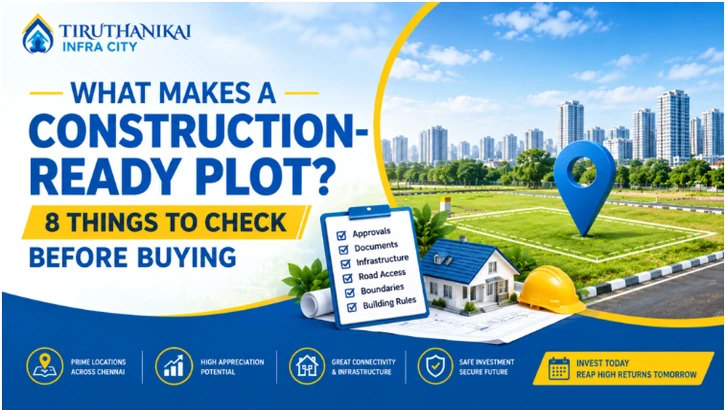
Construction-ready plots can make the journey from buying land to building a home much easier. In Tamil Nadu, 33,559 residential building permits were issued by urban local bodies during 2023–24, showing the scale of regulated residential construction. For buyers, the real question is not simply whether a plot is available—it is whether the plot has clear ownership, approved planning status, proper road access, suitable dimensions, and the conditions needed for construction approval. Official Tamil Nadu systems also require details such as survey number, subdivision, plot number, land use, road type, and registered professionals during the building-approval process. Understanding these checks before purchasing can help buyers avoid unexpected documentation, planning, or construction delays and make a more informed property decision.
8 Things That Make a Plot Ready for House Construction
A construction-ready plot needs more than a good location and attractive price. Buyers should check eight practical factors before planning their dream home: planning approval, clear ownership, legal road access, accurate dimensions, essential infrastructure, suitable site conditions, planning restrictions, and building approval requirements. Tamil Nadu’s approval systems already check details such as survey numbers, subdivision numbers, plot numbers, land use, road type, ownership documents, and approved layout documents. The state’s Single Window Portal has also processed thousands of planning applications, showing how important formal approvals are in the construction process. Checking these factors early helps buyers identify problems before purchasing and move toward house construction with greater clarity.
Proper Layout or Planning Approval
A properly approved layout gives buyers a clearer starting point for house construction. Before purchasing, check whether the plot appears in the approved layout and whether its plot number, dimensions, roads, and land-use details match the documents. Tamil Nadu’s building-approval system specifically asks for an approved layout document, survey number, subdivision number, plot number, proposed usage, and road type. The state also provides an online facility to search layout approvals, making verification easier. As a practical example, if a seller shows a plot as residential but the approved records show different land-use details, stop and verify the discrepancy before proceeding. Proper planning approval helps buyers understand whether the plot fits the intended residential development.
Clear Ownership and Property Documents
Clear ownership gives buyers confidence that the person selling the plot has the legal right to transfer it. Do not rely only on a brochure or verbal assurance. Match the seller’s details across the sale deed, revenue records, survey information, and other relevant documents. Tamil Nadu’s building-approval portal records the mode of property acquisition, including sale deed, inheritance, gift or settlement, court order, government assignment, and family partition.
Before buying, check:
- Sale deed and parent documents
- Encumbrance Certificate
- Patta and relevant revenue records
- Survey and subdivision numbers
- Plot extent and boundaries
- Seller’s ownership details
If these details do not match, ask a qualified property lawyer to review the documents before making a commitment.
Legal Road Access to the Plot
A plot needs clear and lawful access before you plan construction. Check the road shown in the approved layout and compare it with the physical road available at the site. Tamil Nadu planning documents require layout information to identify existing and proposed roads, access routes, road dimensions, and related street details. The building-approval process can also require approach-road details in relevant cases. For example, a plot may look accessible from a nearby street, but the approved plan may show a different access route. Another plot may have a narrow physical approach that creates difficulties for construction vehicles and material delivery. Always verify the legal access, road width, and layout records before buying.
How Buyers Can Verify Whether a Plot Is Construction Ready
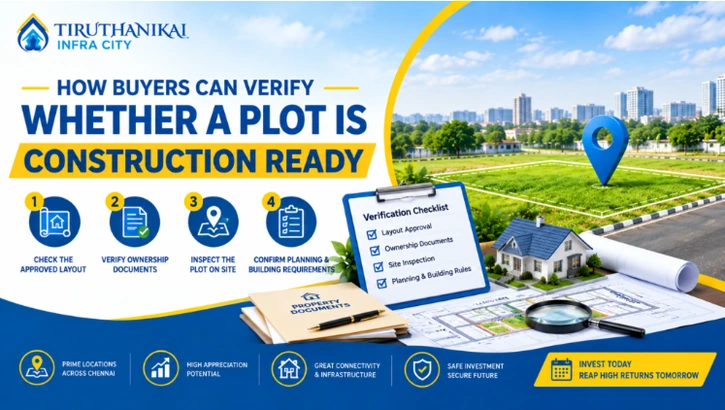
Buyers should verify a plot from documents, official records, and the physical site before planning a house. Tamil Nadu’s building-approval system checks details such as the survey number, subdivision number, plot number, land use, road type, approved layout document, and site extent. A practical verification process should cover four steps: check the approved layout, verify ownership documents, inspect the plot on site, and confirm applicable planning and building requirements. Compare the measurements and identifiers across documents instead of relying on a seller’s brochure. If any detail differs, pause the purchase and seek professional verification. This simple process can help buyers identify documentation, access, boundary, or planning issues before construction begins.
Check the Approved Layout
Start by checking whether your plot appears in the approved layout and whether its details match the documents. Tamil Nadu’s official building-approval system asks for the approved layout document along with the survey number, subdivision number, plot number, proposed use, road type, and site extent. The state’s municipal portal also provides a Layout Approval Search facility for verification.
Compare these details carefully:
- Plot number
- Survey and subdivision numbers
- Plot dimensions and area
- Road access
- Residential land use
- Approved layout number
For example, if the seller says Plot No. 24 measures 1,200 sq. ft., but the approved layout shows a different extent or plot number, do not ignore the mismatch. Verify it with the relevant authority or a qualified professional before proceeding.
Verify Ownership Documents
Clear ownership helps buyers avoid disputes and documentation problems later. Tamil Nadu’s building-approval requirements include ownership details and documents such as sale deeds, parent documents, and relevant land records. For certain planning applications, the official checklist also includes an Encumbrance Certificate, parent documents, sale deed, and Town Survey Land Records/FMB with Chitta and Adangal.
| Document | What to Check |
|---|---|
| Sale Deed | Owner name, extent, boundaries |
| Parent Documents | Previous ownership history |
| Encumbrance Certificate | Registered transactions or claims |
| Patta / Revenue Records | Survey and ownership details |
| FMB / Survey Records | Boundaries and measurements |
Match the survey number, subdivision, extent, and owner name across documents. If the details conflict, ask a qualified property lawyer to review them before purchasing.
Verify the Plot on Site
Never depend only on documents or photographs. Visit the actual plot and compare its physical location with the approved layout and property records. Tamil Nadu’s approval process considers site extent against the extent shown in the patta and registered documents, using the applicable extent for approval. Check the boundaries, road access, dimensions, surrounding development, drainage, and visible site conditions during your visit. For example, a document may show a 30 × 40 ft plot, but the physical boundaries could differ because of fencing or neighboring development. Similarly, a layout may show a road beside the plot while the actual access appears narrower or obstructed. Take measurements with a qualified surveyor when necessary and compare them with the approved records before finalizing the purchase.
Common Mistakes Buyers Make When Choosing a Construction-Ready Plot
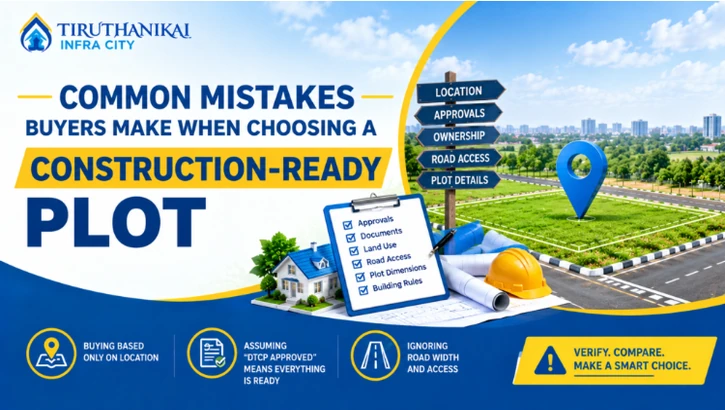
Buying a plot for immediate house construction requires more than checking its price and location. Buyers often overlook approval details, ownership records, road access, plot dimensions, and site conditions. Tamil Nadu’s official building-approval system checks several details, including survey number, subdivision number, plot number, land use, road type, approved layout documents, and site extent. These checks show why buyers should verify the complete property record before making a decision. Common mistakes include choosing a plot based only on location, assuming layout approval covers every construction requirement, ignoring road width, and skipping physical site verification. A careful document review and site inspection can help buyers identify issues before they invest in construction.
Buying Based Only on Location
A popular location can attract buyers, but location alone does not make a plot suitable for house construction. A plot may sit near schools, transport, shops, or major roads yet still have documentation, access, or planning issues. Tamil Nadu’s approval system checks details such as land use, survey number, plot number, road type, and approved layout documents. Buyers should therefore evaluate the property beyond its surroundings.
Before choosing a plot, check:
- Approved layout and planning status
- Ownership and property documents
- Road access and width
- Plot dimensions and boundaries
- Applicable building requirements
For example, a plot near a main road may look attractive, but a narrow internal access road could create practical difficulties during construction. A good location should support the plot—not replace proper verification.
Assuming “DTCP Approved” Means Everything Is Ready
“DTCP approved” can give buyers confidence, but it does not automatically mean they can start house construction without further checks. Layout approval and building approval serve different purposes. Tamil Nadu’s official building-approval system separately asks for an approved layout document, land-use details, road type, site extent, proposed usage, and building information. The applicable building rules also continue to govern matters such as setbacks and road-related requirements.
Before buying, check:
- Whether the specific plot appears in the approved layout
- Whether the survey and subdivision numbers match
- Whether the plot has suitable road access
- Whether the proposed house follows applicable building rules
- Whether further building approval is required
So, treat “DTCP approved” as one important verification point, not as a blanket guarantee that every construction requirement has already been completed.
Ignoring Road Width and Access
Road access affects how easily you can reach and develop a plot. Buyers should compare the road shown in the approved layout with the actual road at the site. Tamil Nadu’s official approval system records road type, while certain approval applications also require approach-road details. Planning rules can also connect road width with development and building requirements.
For example, imagine a plot advertised with convenient road access, but the physical approach becomes very narrow near the site. Construction vehicles, material delivery, and future access may then require additional planning.
Another example: the layout may show a proposed road, while the buyer assumes it already exists on the ground.
Before purchasing, compare:
- Approved road width
- Physical road width
- Access from the public road
- Road alignment shown in the layout
- Any approach-road documentation
Never judge road access from photographs alone; inspect the route personally.
What Is a Construction-Ready Plot?
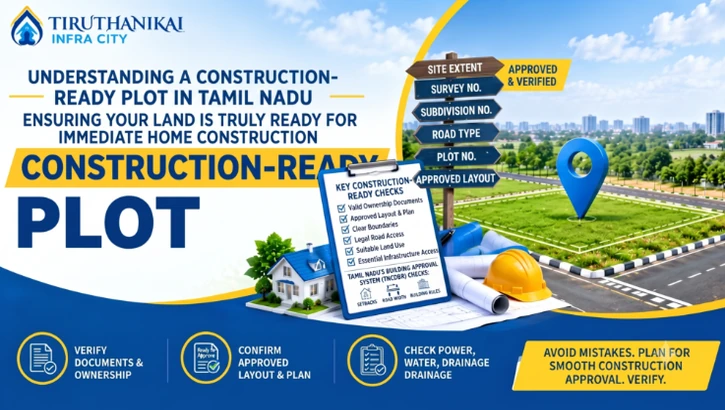
A construction-ready plot is a residential plot where the key checks needed before house construction are already in place. It should have valid ownership documents, an approved layout, clear boundaries, legal road access, suitable land use, and access to essential infrastructure. Tamil Nadu’s building-approval system checks details such as survey number, subdivision number, plot number, road type, approved layout, site extent, and ownership documents. Building rules also consider road width and setbacks before construction. For example, the TNCDBR includes road-width-based setback requirements. So, construction-ready does not simply mean “a plot for sale”; it means the property has fewer unresolved checks before you move toward house planning and approval.
Construction-Ready vs. Just a Saleable Plot
A saleable plot can have clear ownership and a valid transaction path, but that alone does not confirm that you can immediately construct a house. A construction-ready plot requires additional checks covering planning, access, site conditions, and building requirements. Tamil Nadu’s official approval process separately considers land use, survey details, approved layout documents, road type, plot extent, and ownership.
| Check | Saleable Plot | Construction-Ready Plot |
|---|---|---|
| Ownership | Clear documents | Clear and verified |
| Layout | May need verification | Approved and verified |
| Road access | Available | Suitable and verified |
| Plot details | Measured | Matches records and site |
| Construction | Further checks needed | Ready for approval process |
In simple terms: saleability answers “Can I buy it?” while construction readiness asks “Can I move toward building on it?”
Can You Build Immediately After Buying a Plot?
Buying a plot does not automatically mean you can start construction the next day. You still need to confirm the applicable planning and building requirements for that specific property. Tamil Nadu’s official system asks for survey/subdivision details, plot number, land use, road type, approved layout documents, site extent, ownership documents, and building information. Some applications also require site plans, approach-road details, and other documents depending on the property and project.
| Stage | What to Check |
|---|---|
| 1. Buy | Verify ownership and documents |
| 2. Confirm | Check approved layout and plot details |
| 3. Plan | Check setbacks, road access and applicable rules |
| 4. Apply | Obtain required planning/building permission |
| 5. Build | Start after the required approvals |
So, a construction-ready plot can simplify the process, but “ready” does not mean skipping statutory approvals.
Availability of Essential Infrastructure
A plot may look ready on paper but still create problems if basic infrastructure does not reach the site. Buyers should check practical access to roads, electricity, water supply and drainage or sewage facilities, depending on the location. Tamil Nadu’s approval documentation can require approach-road details and, where applicable, evidence relating to underground drainage facilities or sewage arrangements.
For example, imagine a plot with a good location and approved layout but no practical electricity connection nearby. You may need additional arrangements before construction can progress smoothly. Another example is a plot with road access but no suitable drainage connection, which can affect house planning and site development.
Before buying, check:
- Actual road access
- Electricity availability
- Water source or connection
- Drainage/sewage arrangements
- Stormwater flow around the site
A construction-ready plot should work practically, not just look attractive in the brochure.
Conclusion
Choosing a plot for house construction involves more than finding a good location or attractive price. A truly construction-ready plot should have clear ownership, approved planning documents, proper road access, accurate boundaries, essential infrastructure, and no major restrictions that could delay construction. Checking these factors before purchase can help buyers avoid unexpected costs, approval issues, and construction delays. Before making your final decision, verify the documents, inspect the plot personally, and confirm the applicable building requirements. The right plot can make the journey from buying land to building your dream home much smoother. Looking for construction-ready plots in Chennai? Explore our available residential plots and choose a property that fits your location, documentation, and house-building requirements. Contact us today to find the right plot for your future home.
FAQs
1. What is a construction-ready plot?
A construction-ready plot has verified documents, approved planning, road access, and essential infrastructure for house construction.
2. Can I build immediately after buying a plot?
Not always. You must check applicable planning rules and obtain the required building approvals before construction.
3. Does DTCP approval mean I can start construction?
No. DTCP layout approval does not replace the building approval or other requirements for your proposed house.
4. Why is road access important for a construction-ready plot?
Proper road access supports daily use and construction activities such as transporting materials and equipment to the site.
5. What documents should I check before buying a plot?
Check the sale deed, parent documents, encumbrance records, patta, survey details, boundaries, and approved layout documents.
6. Why should I verify the plot boundaries?
Matching the physical boundaries with the approved documents helps prevent disputes and measurement-related problems later.
7. What infrastructure should a construction-ready plot have?
Check practical access to roads, electricity, water supply, and suitable drainage or sewage arrangements before purchasing.
8. Does location alone make a plot construction-ready?
No. A convenient location cannot replace proper approval, documentation, access, infrastructure, and site verification.
9. How can I verify whether a plot is construction-ready?
Compare the approved layout and property documents with the actual site, then confirm the applicable building requirements.
10. Why should I inspect a plot before buying it?
A physical inspection can reveal differences in road access, boundaries, site conditions, and infrastructure that photographs may not show.