

Chennai’s growing employment hubs, expanding infrastructure, and residential demand make property investment an option worth exploring. However, choosing the wrong location, overlooking legal approvals, or paying above market value can turn a promising purchase into a financial burden. Before exploring real estate investment opportunities in Chennai, buyers should assess connectivity, neighbourhood development, property prices, and long-term demand. According to the Ministry of Statistics and Programme Implementation, India’s real estate and construction sectors contribute to economic activity, while Chennai’s investment potential varies significantly by locality and property type. A successful purchase requires more than attractive marketing claims. This guide explains the key benefits of property investment, locations to evaluate, essential documents to verify, and practical buying tips to help you make an informed decision.
H2: Why Consider Real Estate Investment Opportunities in Chennai?
Chennai attracts property investors through its employment hubs, growing residential communities, and expanding infrastructure. The city offers options ranging from residential plots to apartments and independent houses, helping buyers match investments with their budgets and goals. According to Knight Frank India, Chennai recorded 18,262 residential property sales in 2025, marking a 12% year-on-year increase. This growth highlights continued housing market activity, although returns vary by location and property type. Before investing, compare property prices, verify legal approvals, and assess future connectivity. Explore Tiruthanikai Infracity to learn more about residential property options and evaluate whether they suit your investment plans.
Chennai’s Economic Growth and Housing Demand
Chennai’s diverse economy supports its residential property market. The city attracts professionals through IT services, automobile manufacturing, healthcare, education, and other industries, creating housing needs near employment centres. According to Knight Frank India’s 2025 residential market report, Chennai recorded 18,262 housing sales in 2025, a 12% increase year-on-year, while average residential prices rose 7% to ₹5,135 per sq. ft.
Residential Market
These figures highlight market activity, but they do not guarantee future returns.
Investors should compare established neighbourhoods with developing residential corridors and assess local demand before buying. Review employment access, schools, hospitals, transport, and nearby amenities. If you are considering buying land for future construction or long-term ownership, explore residential plots in Chennai and compare available options with your budget and location preferences.
Infrastructure Development and Connectivity
Infrastructure can influence property demand by improving access to workplaces, schools, hospitals, and commercial centres. Chennai Metro Rail’s Phase II project covers 118.9 km across three corridors, with 128 stations planned, connecting areas from Madhavaram to SIPCOT, Lighthouse to Poonamallee Bypass, and Madhavaram to Sholinganallur.
Press Information Bureau
Better connectivity may improve a property’s appeal, but buyers should distinguish operational infrastructure from projects still under construction.
Before investing, assess these factors:
- Metro connectivity: Check the distance to operational stations and the verified status of planned extensions.
- Road access: Evaluate major roads, commute times, and access to employment hubs.
- Essential amenities: Check nearby schools, hospitals, shops, and public transport.
- Local infrastructure: Investigate drainage, water supply, road conditions, and flood exposure.
Before choosing a plot, evaluate connectivity, nearby amenities, and local infrastructure, then explore residential plots in developing locations that align with your requirements.
Long-Term Investment Potential
Real estate can support long-term financial goals when buyers select suitable properties, manage costs, and allow sufficient time for growth. Knight Frank India’s 2025 report recorded a 7% year-on-year increase in Chennai’s average residential property prices, reaching ₹5,135 per sq. ft.
Residential Market
However, citywide averages cannot predict the performance of an individual plot or property.
Consider these examples:
- Residential plot: An investor buys land in a legally approved layout near established roads and amenities, intending to hold it for several years. Future returns depend on local demand, purchase price, and infrastructure development.
- Apartment investment: A buyer chooses a property near an employment hub and earns rental income, while accounting for maintenance, vacancy, taxes, and loan costs.
- Future home construction: A family purchases a suitable plot for a home they plan to build later, prioritising access to schools, healthcare, and daily necessities.
To take the next step, explore residential property investment options and verify the property’s legal approvals, total purchase costs, and location-specific growth prospects before investing.
Types of Real Estate Investment Opportunities in Chennai
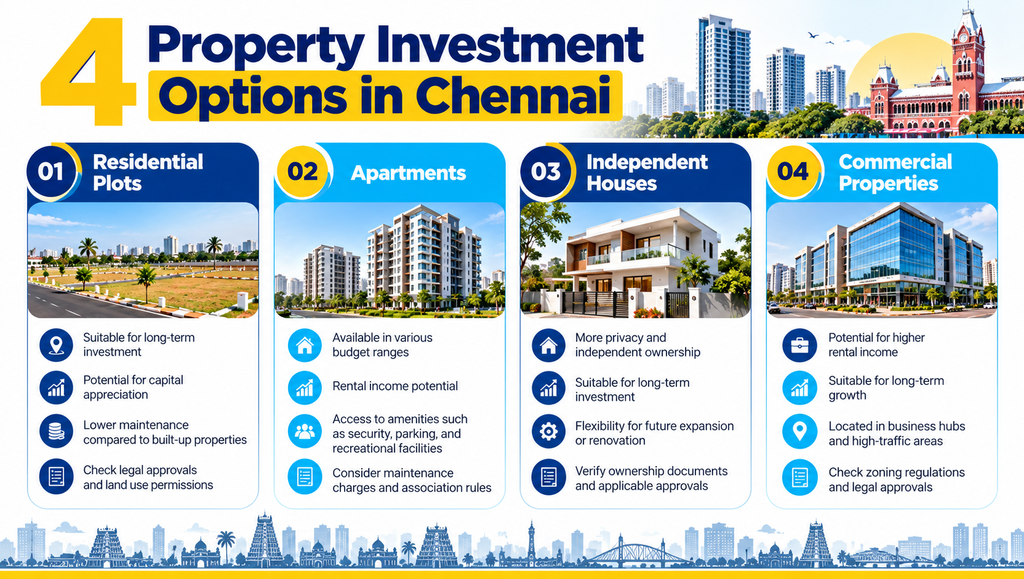
Chennai offers several property investment options for buyers with different budgets and financial goals. You can consider residential plots, apartments, independent houses, or commercial properties depending on your investment timeline and risk tolerance. Knight Frank India’s 2025 residential market report recorded 18,262 residential property sales in Chennai, reflecting a 12% year-on-year increase.
This activity highlights the city’s housing market, although it does not guarantee future returns. Before choosing a property, compare purchase prices, location advantages, legal approvals, and potential resale demand. Review reliable market reports and official records to make an informed investment decision.
To take the next step, explore residential property investment options and verify the property’s legal approvals, total purchase costs, and location-specific growth prospects before investing.
Residential Land Investment in Chennai
Residential land investment in Chennai appeals to buyers who want to build a home, hold an asset for the long term, or explore potential capital appreciation. Chennai recorded 18,262 residential property sales in 2025, up 12% year-on-year, according to Knight Frank India’s residential market report.
However, this figure covers housing sales and does not specifically measure vacant plot transactions.
Before buying a plot, check the following:
- Legal approvals: Verify the title deed, ownership history, encumbrance certificate, and applicable layout approvals.
- Location: Assess road access, water supply, drainage, and nearby amenities.
- Budget: Include registration charges, stamp duty, legal fees, and development costs.
- Future demand: Compare local prices and actual infrastructure progress.
If you are exploring land investment options, visit Tiruthanikai Infracity to learn more about residential property opportunities and evaluate options that align with your long-term investment goals.
Apartment and Independent House Investments
Apartments and independent houses can suit buyers seeking rental income, future occupancy, or long-term ownership. Apartments may offer shared amenities and easier property management, while independent houses can provide greater privacy and land ownership benefits, subject to the property’s legal structure. Knight Frank India reported a 7% year-on-year rise in Chennai’s average residential property price in 2025, reaching ₹5,135 per sq. ft.
Residential Market
This citywide average does not predict the price movement of every property.
Compare the options before making a decision:
| Factor | Apartments | Independent Houses |
| Initial cost | Varies by size, location, and amenities | Varies by land size, location, and construction |
| Rental potential | May suit tenants near workplaces | May attract families seeking more space |
| Maintenance | Often includes shared maintenance fees | Owner manages most maintenance |
| Land ownership | Usually includes an undivided share, subject to documents | Depends on the title and property structure |
| Key checks | Building approvals, RERA where applicable, maintenance costs | Land title, building approvals, boundaries, and structural condition |
Check project details through Tamil Nadu RERA where applicable, and compare rental demand before investing.
Commercial Property Investment
Commercial property investment in Chennai includes office spaces, retail shops, warehouses, and other business premises. These properties may generate rental income, but returns depend on tenant demand, location, lease terms, vacancy, and maintenance expenses. Cushman & Wakefield reported that Chennai’s office market recorded 8.99 million sq. ft. of gross leasing in 2025, a 23% year-on-year increase.
sch.cushmanwakefield.com
This figure indicates office leasing activity, not guaranteed returns for individual investors.
Consider these examples:
- Office space: An investor purchases a unit near an employment hub and leases it to a business. The investor must assess tenant quality, lease duration, and vacancy risk.
- Retail shop: A shop in a well-connected commercial area may attract service businesses, depending on footfall and local demand.
- Warehouse: A property near transport routes may appeal to logistics operators, subject to access, zoning, and facility requirements.
Best Locations to Evaluate for Property Investment in Chennai
Choosing the right location plays a major role in property investment. Chennai offers established residential neighbourhoods, IT corridors, and developing suburbs, each with different price ranges and investment considerations. Knight Frank India’s 2025 residential market report recorded 18,262 home sales in Chennai, a 12% year-on-year increase, highlighting continued market activity. However, property values and demand vary significantly between locations. Compare connectivity, employment opportunities, schools, hospitals, water supply, and future infrastructure before purchasing. Check recent transaction prices rather than relying solely on advertised rates. A location that suits your budget, intended use, and investment timeline can help you make a more informed decision.
Established Residential Neighbourhoods
Established residential neighbourhoods such as Velachery, Porur, and parts of Anna Nagar attract buyers who value existing amenities and convenient access to daily essentials. These areas offer access to schools, hospitals, supermarkets, public transport, and employment centres, although prices vary by street, property type, and connectivity. Knight Frank India reported that Chennai’s average residential prices rose 7% year-on-year in 2025, reaching ₹5,135 per sq. ft.
This citywide average provides context, but it does not reflect the exact value of each neighbourhood. Before investing, compare recent transactions, rental demand, traffic conditions, and available infrastructure. Established areas may suit buyers who prioritise convenience over speculative growth.
IT and Employment-Driven Corridors
Chennai’s IT and employment corridors attract property investors who want to evaluate housing demand near major workplaces. The Old Mahabalipuram Road (OMR), particularly areas around Sholinganallur and Perungudi, hosts technology companies and supporting businesses. These employment hubs can create demand for rental apartments and nearby residential properties, although local supply and tenant preferences also influence returns.
Before investing, evaluate these factors:
- Employment access: Check travel times to IT parks and major business districts.
- Transport connectivity: Assess access to roads, buses, and operational metro services.
- Rental demand: Compare rents, vacancy levels, and competing residential projects.
- Infrastructure: Check water supply, drainage, schools, healthcare, and road conditions.
- Purchase price: Compare recent transactions with expected rental income and ownership costs.
For example, an apartment near a major IT employment hub may attract working professionals, while a plot farther from workplaces may suit buyers with a longer investment horizon. Verify current local conditions before choosing either option.
Developing Suburban Areas for Residential Plots
Developing suburban areas may interest buyers seeking residential plots at prices that fit their budgets and long-term plans. However, a lower purchase price does not automatically indicate better investment potential. Evaluate existing infrastructure, approved layouts, access roads, water availability, drainage, and actual housing demand before committing funds.
For example, a buyer comparing plots around Poonamallee and Vandalur should assess commute times, nearby amenities, planning approvals, and the status of proposed infrastructure. A plot near functioning roads and established communities may offer greater practical value than one that depends on future projects. Compare recent transactions and calculate the total purchase cost, including registration and development expenses.
If you are exploring residential land options, visit Tiruthanikai Infracity to review property opportunities and assess their suitability for your investment goals. Always verify the property’s title and applicable approvals independently before buying.
Key Benefits of Real Estate Investment in Chennai

Real estate investment in Chennai offers potential benefits for buyers seeking long-term asset growth, rental income, or a future home. The city’s residential market recorded 18,262 property sales in 2025, a 12% year-on-year increase, according to Knight Frank India. Average residential prices also rose 7% during the year. These figures indicate market activity, but they do not guarantee future profits. Your results depend on the purchase price, location, property type, and holding period. Before investing, compare local market trends, verify legal documents, and calculate all ownership costs. A well-researched decision can help you align property ownership with your financial goals.
Potential Capital Appreciation
Capital appreciation occurs when a property’s market value increases over time. Chennai offers several factors worth evaluating, including employment growth, infrastructure improvements, housing demand, and neighbourhood development. Knight Frank India’s 2025 residential market report recorded a 7% year-on-year increase in Chennai’s average residential prices, reaching ₹5,135 per sq. ft.
Residential Market
However, this citywide figure does not guarantee similar growth in every locality.
For example, an investor who purchases a residential plot near established roads, schools, and employment centres may benefit if local demand increases over time. Another buyer may experience slower growth if the area lacks essential amenities or attracts limited demand. Compare recent property transactions, assess infrastructure progress, and consider your holding period before investing. Always calculate transaction costs and avoid relying solely on projected appreciation.
Rental Income and Future Use
Property investment can provide rental income or support future residential plans, depending on the asset you choose. Apartments and independent houses may attract tenants, while vacant residential plots generally do not generate conventional rental income. Your returns depend on location, tenant demand, maintenance expenses, taxes, and vacancy periods.
Use this comparison to evaluate your options:
| Investment type | Potential benefit | Key consideration |
| Apartment | Monthly rental income | Maintenance fees and tenant vacancies |
| Independent house | Rental income and future personal use | Repairs, upkeep, and property management |
| Residential plot | Future home construction or resale | Holding costs and local demand |
| Commercial property | Rental income from business tenants | Lease terms and vacancy risk |
For example, an apartment near an IT employment hub may appeal to working professionals, while a plot may suit a family planning to build a home in five years. Calculate expected income and expenses before choosing an investment.
Portfolio Diversification and Tangible Ownership
Real estate can complement other investments by adding a physical asset to your portfolio. However, buying property does not automatically reduce risk, especially when you commit most of your savings to one location or asset. Property also requires substantial upfront capital and may take time to sell.
Consider these examples:
- Diversifying investments: An investor holds equity funds and fixed-income investments alongside a residential property. This approach spreads money across different asset types, although each carries its own risks.
- Building a future home: A family purchases a legally approved residential plot and plans construction when finances permit. The land supports a practical goal while creating potential long-term value.
- Generating rental income: An investor buys an apartment and rents it to tenants, using the income to offset ownership expenses.
Before purchasing, maintain an emergency fund and compare property costs with your other financial goals. Evaluate title documents, location demand, liquidity, and ongoing expenses to understand whether the property fits your overall investment strategy. If you are exploring real estate investment opportunities in Chennai, review the available residential property options and assess their location, legal approvals, total costs, and suitability for your long-term investment goals.
How to Evaluate Real Estate Investment Opportunities in Chennai Before Buying
Choosing the right property requires more than comparing prices or attractive advertisements. Before exploring real estate investment opportunities in Chennai, assess your budget, investment timeline, location, expected returns, and legal requirements. Knight Frank India’s 2025 report recorded 18,262 residential property sales in Chennai, highlighting continued market activity. However, market growth does not guarantee profits for individual buyers. Compare recent transactions, investigate local infrastructure, and calculate additional expenses such as registration fees, maintenance, and taxes. Verify ownership documents and applicable approvals before paying an advance. A structured evaluation helps you identify suitable properties, avoid preventable risks, and make a more informed investment decision.
Set Your Budget and Investment Timeline
Start by deciding how much you can invest without affecting your household expenses or emergency savings. Your budget should cover more than the property’s purchase price. Include stamp duty, registration charges, legal fees, loan interest, maintenance, and potential development costs. Next, define your investment timeline. If you plan to build a home within two years, prioritise accessibility and essential amenities. If you intend to hold a plot for ten years, examine long-term demand and infrastructure plans. Chennai’s residential market recorded 18,262 home sales in 2025, according to Knight Frank India, but this figure does not guarantee future returns. Explore real estate investment opportunities in Chennai to review property options that may align with your budget and goals.
Compare Property Prices and Expected Returns
Compare similar properties in the same locality before deciding whether an asking price offers reasonable value. Chennai’s average residential prices rose 7% year-on-year in 2025, reaching ₹5,135 per sq. ft., according to Knight Frank India. However, prices differ by neighbourhood, property type, and development status. Use recent transactions and realistic income estimates rather than relying on advertised appreciation claims.
Consider these factors:
- Comparable prices: Check recent transactions for properties with similar sizes and locations.
- Rental yield: Divide annual rental income by the property’s purchase price, then calculate net yield after expenses.
- Additional costs: Include registration, taxes, maintenance, repairs, and loan interest.
- Resale potential: Assess local demand and how quickly you might sell the property.
- Market evidence: Review reports from Knight Frank India and compare their findings with local property data.
For example, a lower-priced plot may offer poor value if it lacks road access or essential infrastructure. Verify Legal Documents and Approvals
Legal verification helps you avoid ownership disputes, unauthorised layouts, and unexpected restrictions. Before purchasing a plot or home, ask a qualified property lawyer to examine the documents and confirm the property’s legal status. Never rely solely on a seller’s assurances or marketing materials.
Check these essential records:
- Title deed: Confirm the seller’s ownership and review the chain of title.
- Encumbrance certificate: Check registered transactions and encumbrances reflected in the relevant records.
- Planning and layout approvals: Confirm that the competent authority approved the layout and permitted the intended land use.
- Survey records: Match the survey number, boundaries, and plot measurements with official records.
- RERA registration: For applicable projects, verify registration and project details through Tamil Nadu RERA.
- Registration records: Use the Tamil Nadu Registration Department for relevant registration services and records.
For example, a seller may advertise a plot as approved, but the approval may not cover that specific survey number. Verify the documents independently before paying an advance.
Common Risks and Mistakes to Avoid When Investing in Chennai Property
Real estate investment in Chennai can offer long-term opportunities, but poor decisions can lead to financial losses, legal disputes, and resale difficulties. Buyers often focus on attractive prices while overlooking ownership documents, infrastructure, flood exposure, and additional expenses. Chennai’s residential property prices rose 7% year-on-year in 2025, according to Knight Frank India, but this increase does not guarantee future appreciation for every property. Before purchasing, investigate the location, compare market prices, verify approvals, and calculate the total cost of ownership. Careful research helps you avoid common mistakes and choose a property that suits your budget and investment goals.
Buying Without Verifying Ownership and Approvals
Buying property without checking ownership documents and planning approvals can expose you to disputes, financial losses, and difficulties reselling the property. Never rely solely on a developer’s brochure, agent’s promises, or a seller’s assurance. Ask a qualified property lawyer to examine the title deed, ownership history, encumbrance certificate, survey records, and applicable planning approvals.
For example, a seller may advertise a residential plot as approved, but the approval may not cover the specific survey number you intend to purchase. Verify the layout and land-use permissions with the relevant planning authority. For applicable projects, check registration details through Tamil Nadu RERA. Also review relevant registration records through TNREGINET. Complete these checks before paying an advance or signing an agreement.
Overlooking Infrastructure and Flood Risk
A property’s location can influence its long-term value, accessibility, and resale demand. However, buyers sometimes focus on nearby highways or proposed metro stations without checking drainage, water supply, road access, and flood exposure. Chennai’s history of significant flooding highlights the importance of evaluating local conditions rather than relying on location-based marketing claims.
Compare these factors before investing:
| Factor | What to check |
| Flood exposure | Review local flood history, low-lying areas, and official hazard information. |
| Drainage | Inspect stormwater drains and waterlogging after heavy rain, where possible. |
| Road access | Check road conditions and year-round access to the property. |
| Water supply | Assess local availability and the reliability of water sources. |
| Infrastructure projects | Verify project status through official government sources instead of relying on announcements. |
For example, a plot near a proposed road may appear attractive, but delays or changes to the project could affect its investment potential. Inspect the site and verify local conditions before purchasing.
Underestimating Costs and Resale Limitations
The property’s advertised price rarely represents your total investment. Buyers must account for stamp duty, registration charges, legal fees, loan interest, maintenance, taxes, and potential development expenses. These costs can reduce your returns, particularly if you sell sooner than planned.
For example, an investor who purchases a residential plot may later discover that boundary work, site levelling, or access improvements require additional spending. If the investor needs to sell quickly, limited buyer demand could also force a lower asking price.
Before committing funds, consider:
- Purchase costs: Calculate registration, stamp duty, legal fees, and applicable taxes.
- Ongoing expenses: Budget for maintenance, loan repayments, and property-related charges.
- Resale demand: Compare recent transactions and assess the likely time needed to find a buyer.
- Emergency funds: Keep enough savings to cover unexpected expenses without selling the property prematurely.
Explore real estate investment opportunities in Chennai to review relevant residential property options, and independently verify their total costs, legal status, and suitability for your investment timeline.
Conclusion
Exploring real estate investment opportunities in Chennai requires careful planning, location research, and legal verification. Whether you choose a residential plot, apartment, independent house, or commercial property, evaluate the purchase price, infrastructure, future demand, and total ownership costs before investing. Check ownership documents and applicable approvals, compare market prices, and set realistic expectations for rental income and capital appreciation. Remember that property values can fluctuate, and no investment guarantees returns.
If you’re planning to invest in Chennai property or build your future home, explore Tiruthanikai Infra City for information about DTCP-approved residential plots and villas. Review the available property details, verify the relevant approvals, and choose an option that aligns with your budget and long-term goals.
Frequently Asked Questions (FAQs)
1. Is Chennai a good city for real estate investment?
Chennai can offer property investment opportunities through its IT corridors, established residential neighbourhoods, and developing suburbs. Buyers should compare property prices, infrastructure, housing demand, and legal approvals before investing. Returns depend on location, property type, purchase price, and holding period.
2. Which areas in Chennai are worth considering for property investment?
Velachery, Porur, Anna Nagar, Perungudi, Sholinganallur, and Poonamallee are areas buyers can evaluate based on their budgets and investment goals. Compare connectivity, employment hubs, essential amenities, current prices, and local demand before selecting a property.
3. Is residential land investment in Chennai better than buying an apartment?
Residential land may suit buyers seeking future construction or long-term appreciation, while apartments may offer rental income and immediate occupancy. Land generally requires additional planning for construction, whereas apartments involve maintenance and association fees. The better option depends on your budget, investment timeline, and financial goals.
4. What documents should I check before buying a residential plot in Chennai?
Check the title deed, ownership history, encumbrance certificate, survey records, applicable layout approvals, land-use classification, and access rights. Verify relevant records through the Tamil Nadu Registration Department and consult a qualified property lawyer before paying an advance.
5. How much money is needed to invest in real estate in Chennai?
The investment amount depends on the location, plot size, property type, and development status. Include the purchase price, stamp duty, registration charges, legal fees, applicable taxes, and potential development expenses when calculating your budget. Compare properties within your financial limits before making a decision.
6. How can I identify a reliable real estate developer in Chennai?
Review the developer’s track record, completed projects, ownership documents, planning approvals, construction quality, and delivery history. Check applicable project registration through Tamil Nadu RERA. Verify claims independently rather than relying solely on advertisements or sales representatives.
7. Can residential plots generate rental income?
Vacant residential plots generally do not generate conventional residential rental income. However, certain permitted land uses or leasing arrangements may generate income, depending on local regulations and demand. Buyers should assess whether they want rental income, future construction, or potential long-term appreciation.
8. How do I calculate the potential return on a property investment?
Estimate your potential return by comparing the property’s expected selling price or rental income with its purchase price and associated expenses. Include registration charges, maintenance, taxes, loan interest, and selling costs. For rental properties, calculate net rental yield after expenses. Treat projections as estimates rather than guaranteed returns.
9. What risks should buyers consider before investing in Chennai real estate?
Buyers should assess unclear ownership, unauthorised layouts, flood exposure, inadequate drainage, infrastructure delays, oversupply, unexpected expenses, and limited resale demand. Inspect the location, verify legal documents, compare market prices, and maintain sufficient financial reserves before investing.
10. How can I verify whether a residential plot is legally approved in Chennai?
Identify the relevant planning authority and independently verify the layout approval, land-use classification, title documents, survey details, and applicable permissions. Check project registration through Tamil Nadu RERA where applicable. A qualified property lawyer can help confirm the documents and identify potential legal risks before purchase.