Enquire Now for a free site visit – call

Introduction
Buying a plot without verifying approvals is one of the costliest real estate mistakes in Tamil Nadu. Many buyers assume that registration or local body approval is enough only to face loan rejections, construction bans, or legal notices later. According to industry and banking reports, nearly 60–65% of plot-related loan rejections happen due to missing or improper DTCP approvals, and unapproved layouts account for a major share of land disputes in the state [eba europa]
That’s where this DTCP Approved Plot Checklist becomes essential.
This guide is designed to help you verify the right documents before paying any advance, so you don’t rely on agent promises or incomplete paperwork.
In this blog, you’ll learn:
- What a DTCP approved plot legally means
- The exact documents you must verify before booking
- How to avoid illegal layouts and future penalties
- How this checklist protects your investment and resale value
If you’re planning to buy land in 2026, this checklist isn’t optional it’s your safety net.
What Is a DTCP Approved Plot?
A DTCP approved plot is a residential plot that has received legal approval from the Directorate of Town and Country Planning (DTCP), Tamil Nadu, confirming that the land development follows state planning rules. In simple terms, DTCP approval means the government has verified the layout, land use, and infrastructure standards so buyers don’t face legal trouble later.
When DTCP approves a plot, it checks whether:
- The land is legally converted for residential use
- Roads meet minimum width norms
- Open Space Reservation (OSR) is properly allocated
- Drainage, access roads, and public utilities follow planning rules
Why DTCP Approval Matters (With a Real Example)
Let’s say two plots cost ₹1,200 per sq.ft:
- Plot A: Panchayat approved
- Plot B: DTCP approved
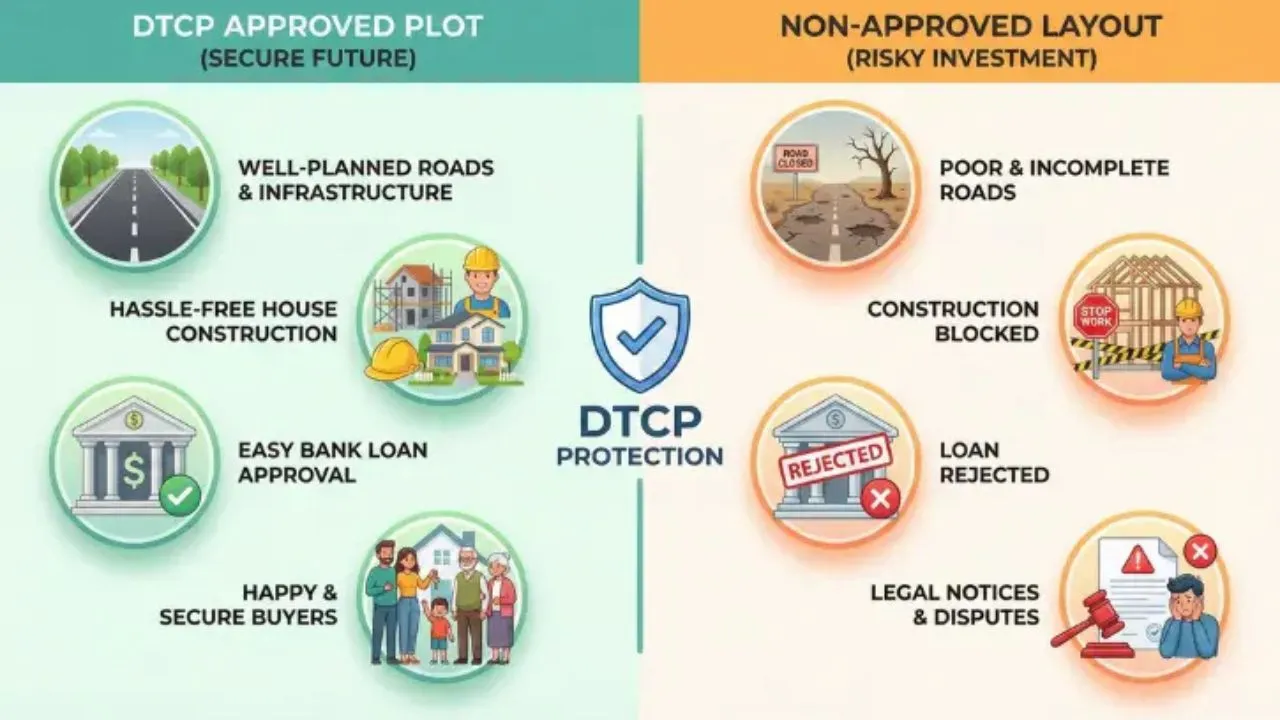
Banks usually reject loans for Plot A, while Plot B qualifies for home loans and construction approvals. That difference directly impacts resale value, safety, and long-term returns.
DTCP Approved vs Non-Approved Plot
| Feature | DTCP Approved Plot | Non-Approved Plot |
| Legal status | Government-verified | Legally risky |
| Bank loan eligibility | Yes | Mostly No |
| Construction approval | Allowed | Often denied |
| Resale value | High | Limited |
| Demolition risk | Nil (if compliant) | High |
In Short
A DTCP approved plot protects you from:
❌ Illegal layouts
❌ Future demolition notices
❌ Loan rejection
❌ Loss of resale value
If you plan to build, invest, or resell safely in 2026, DTCP approval is not optional it’s essential.
Why Verifying DTCP Approval Is Non-Negotiable in 2026
In 2026, buying a plot without verifying DTCP approval is no longer a small risk it’s a serious financial gamble. Tamil Nadu’s planning authorities and banks now strictly enforce land-use and layout regulations. If a plot lacks proper DTCP clearance, buyers face roadblocks at every stage from loan approval to construction.
Here’s the reality: banks reject nearly 6 out of 10 plot-loan applications in Tamil Nadu due to missing DTCP or CMDA approvals. Registration alone doesn’t protect you anymore. Authorities now track unauthorised layouts using digital land records and satellite mapping.
What Happens If You Skip DTCP Verification?
Buyers who don’t verify DTCP approval often face:
❌ Home loan rejection from nationalised and private banks
❌ Building plan approval denial by local bodies
❌ Legal notices or demolition risks in unauthorised layouts
❌ Low or zero resale demand, even after years
A Simple Example
Two buyers purchase plots in the same area:
- Buyer 1 chooses a cheaper, “locally approved” plot
- Buyer 2 verifies DTCP approval before paying advance
Five years later, Buyer 2 builds a house and sells at a premium. Buyer 1 struggles to get construction permission and buyers walk away.
Why 2026 Makes DTCP Verification Critical
- Government digitisation exposes illegal layouts faster
- Banks fund only DTCP-approved developments
- Buyers demand legally clean plots with documentation
In 2026, smart buyers don’t just ask “Is it approved?” they verify DTCP approval before paying even ₹1.
18 Documents You Must Verify Before Paying Advance
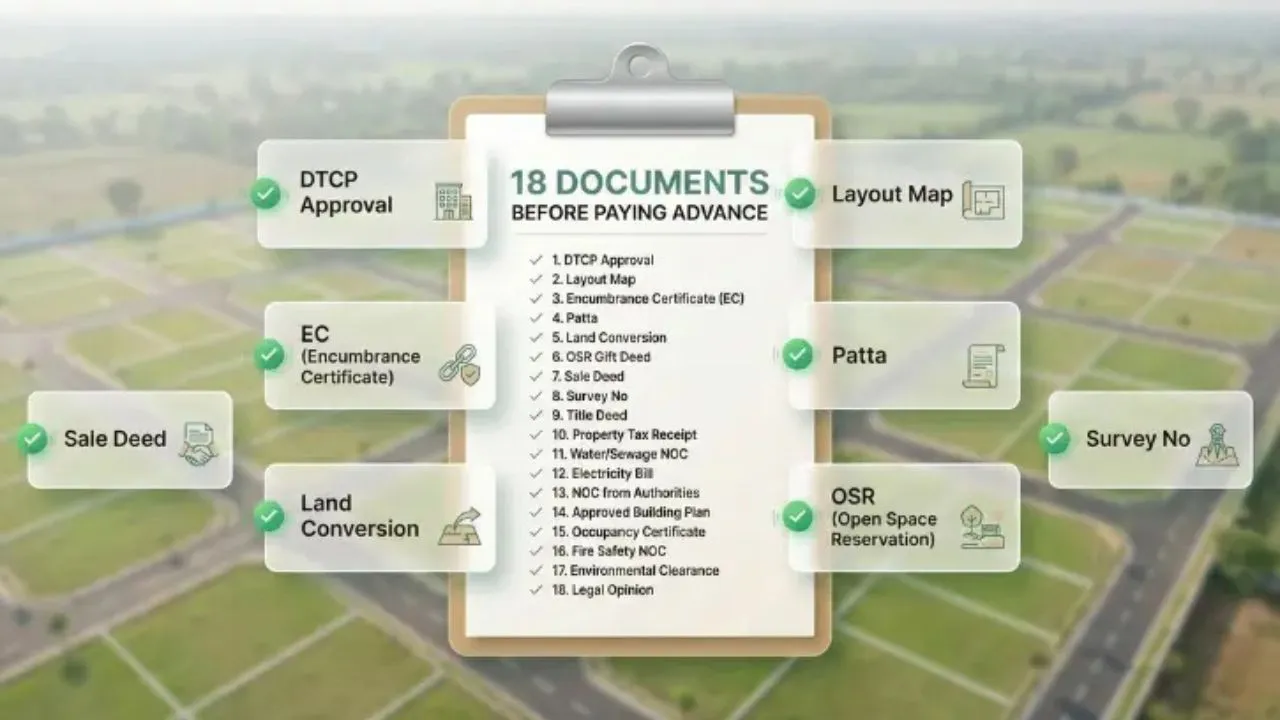
When buying a plot, verbal assurances don’t protect you documents do. Even if a seller claims the land is “DTCP approved,” you must personally verify every record. Missing even one key document can block loans, delay construction, or create legal disputes later.
Below is a practical, buyer-first checklist you should complete before paying any advance.
Core DTCP & Layout Documents
| Category | Documents to Verify |
| DTCP Approval | DTCP approval letter, DTCP reference number |
| Layout Plan | Approved layout map, plot demarcation sketch |
| Infrastructure | Road width confirmation, OSR allocation proof |
| Local Authority | Panchayat / Municipality endorsement |
Ownership & Legal Documents
| Category | Documents to Verify |
| Title Proof | Parent document (30–40 years), latest sale deed |
| Land Records | Patta, Chitta, Adangal |
| Legal Safety | Encumbrance Certificate (EC – minimum 20 years) |
| Land Use | Land conversion order (agricultural → residential) |
Buyer Protection Documents (Often Ignored)
- Sub-Registrar guideline value (to avoid overpricing)
- Utility NOCs (EB, water access, drainage)
- Environmental clearance (for large layouts)
- Sale agreement draft with clear clauses
- Tax receipts and survey number verification
Real-World Example
A buyer pays advance after checking only the sale deed. Later, the bank rejects the loan because the DTCP layout number doesn’t exist online. The deal collapses and the advance gets stuck.
Always verify all 18 documents. A legally clean plot saves money, time, and stress.
How to Cross-Verify DTCP Approval Online
Never rely on printed copies or WhatsApp PDFs when someone claims a plot is DTCP Approved Plot Checklist. In 2026, the only safe way to confirm approval is to cross-verify it online using official DTCP records. This step takes a few minutes and can save you from years of legal trouble.

Step-by-Step: Verify DTCP Approval Online
Follow this simple process before paying any advance:
- Visit the Tamil Nadu DTCP official portal
- Select the approved layouts / planning permission section
- Enter the DTCP layout reference number provided by the seller
- Search using district, village name, or survey number
- Download or view the approved layout details
What You Must Match Carefully
Once the result appears, cross-check these details with the physical documents:
- Survey numbers and sub-division numbers
- Village and taluk name
- Layout boundaries and road widths
- Number of plots and OSR allocation
If even one detail doesn’t match, treat it as a red flag.
Simple Example
An agent shows you a DTCP Approved Plot Checklist letter for a layout in the same village but the survey number differs from your plot. That approval does not apply to your land. Paying advance at this stage can trap your money.
Extra Safety Tip
- Don’t trust “approval under process” claims
- Verify using original reference numbers only
- Cross-check details with a lawyer if unsure
Smart buyers don’t ask “Is it approved?” they verify it online themselves before committing.
Why DTCP Approved Plots Are Better for Long-Term Investment
When you buy land for long-term growth, legality matters more than discounts. DTCP Approved Plot Checklist consistently outperform unapproved plots because they offer security, liquidity, and predictable appreciation. In 2026, smart investors focus on verified approvals, not just low prices.
Key Reasons DTCP Approved Plots Win Long-Term
DTCP approved plots deliver strong investment value because they:
- Qualify easily for bank loans, increasing buyer demand
- Allow legal construction without future hurdles
- Attract end-users, not just speculative buyers
- Carry higher resale value and faster exit options
Unapproved plots may look cheaper today, but they limit your future options.
Real Example: Approval vs Discount
Two investors buy plots in the same locality:
- Investor A buys an unapproved plot at a lower price
- Investor B buys a DTCP approved plot at a slightly higher price
After 6–8 years, Investor B sells faster at a premium because banks fund the purchase and buyers trust the legality. Investor A struggles to find buyers willing to pay full value.
Why DTCP Approval Drives Appreciation
- Government-approved layouts gain infrastructure priority
- Approved road access improves livability and demand
- Legal clarity eliminates buyer hesitation during resale
Long-Term Investor Advantage
DTCP approved plots protect you from:
- Sudden demolition notices
- Frozen resale transactions
- Loan rejections for future buyers
If you want land that grows in value and stays legally safe, DTCP approved plots checklist offer the smartest long-term investment path.
👉 Looking for a 100% DTCP approved plot checklist with clear documents?
Explore legally verified plots at Tiruthanikai Infra City designed for safe investment and stress-free ownership.
Conclusion: Buy Smart, Buy Verified
Buying a plot is not just about location or price it’s about legal clarity and long-term safety. This DTCP Approved Plot Checklist exists to protect you from costly mistakes, illegal layouts, and future uncertainty. By verifying the right documents before paying any advance, you secure loan eligibility, construction approval, and strong resale value.
In 2026, smart buyers don’t rely on promises. They rely on proof, approvals, and proper verification. A DTCP-approved plot gives you peace of mind today and financial confidence tomorrow.
If you’re looking to invest in land that already meets every legal requirement without running from office to office choose a project built on transparency and compliance.
Frequently Asked Questions
1. What does DTCP approved plot mean?
A DTCP approved plot is part of a layout legally approved by the Directorate of Town and Country Planning, Tamil Nadu. It confirms that the land follows government planning, road width, OSR, and land-use norms.
2. Is DTCP approval mandatory to buy a plot in Tamil Nadu?
DTCP approval is not mandatory for registration, but it is essential for construction approval, bank loans, and safe resale.
3. Can I get a bank loan for a DTCP approved plot?
Yes. Most nationalised and private banks prefer or mandate DTCP or CMDA approval before approving plot loans.
4. How can I check if a plot is really DTCP approved?
You can verify the DTCP layout reference number on the official Tamil Nadu DTCP website and cross-check survey numbers and layout details.
5. Is Panchayat approved plot the same as DTCP approved plot?
No. Panchayat approval is local-level permission and does not replace DTCP approval. DTCP approval offers stronger legal protection.
6. What happens if I buy a non-DTCP approved plot?
You may face loan rejection, construction permission denial, resale difficulty, or even legal notices in the future.
7. What is OSR and why is it important in DTCP layouts?
OSR (Open Space Reservation) is mandatory land reserved for public use. DTCP approval requires proper OSR allocation to ensure legal compliance.
8. Can DTCP approval be cancelled later?
DTCP approval remains valid if the developer follows all approved conditions. Violations can lead to penalties or cancellation.
9. Is DTCP approval required for plotting projects outside city limits?
Yes. DTCP approval applies to layouts in non-CMDA areas, including towns, villages, and developing corridors.
10. When should I verify DTCP documents before or after paying advance?
Always verify before paying any advance. Once money is paid, recovering it becomes difficult if documents are incomplete or invalid.