Enquire Now for a free site visit – call


Introduction
Buying property often starts with one important question: Should you choose a plot loan or a home loan? The wrong financing option can affect your upfront costs, repayment period, documentation, and long-term financial planning. plot loan vs home loan According to the Reserve Bank of India (RBI), housing finance includes loans for purchasing or constructing residential units and, under specified conditions, loans for purchasing plots intended for residential construction. This makes understanding the purpose and conditions of each loan essential before committing your money. In this guide, we’ll break down the plot loan vs home loan, covering eligibility, interest rates, tenure, documentation, tax considerations, and key costs. By understanding these differences, property buyers can evaluate their options more confidently and choose financing that aligns with their property plans and repayment capacity.
What Is a Plot Loan? Why a Private Theatre for Business Events Creates Stronger Client Impressions
A plot loan helps buyers finance an eligible residential plot with the intention of building a home. Plot loan vs home loan The Reserve Bank of India (RBI) includes loans for purchasing plots for residential construction within its definition of housing finance, provided the borrower intends to construct a house within the specified period. This makes a plot loan different from simply borrowing money for land as an investment. Before applying, buyers should check the lender’s property requirements, repayment terms, documentation, and construction conditions. A clear understanding of these factors helps buyers plan their finances confidently and avoid surprises later.
What Can a Plot Loan Be Used For?
A plot loan primarily supports the purchase of eligible residential land where the buyer plans to construct a home. RBI guidance specifically recognizes financing for plots intended for residential construction, subject to applicable conditions.
Buyers can generally explore plot financing for:
- Purchasing a residential plot for future house construction.
- Buying land where the lender accepts the property’s legal and planning documents.
- Financing a plot as the first step toward building a residential property.
For example, imagine a buyer purchases a ₹30 lakh residential plot and plans to construct a house later. plot loan vs home loan The buyer should confirm whether the lender permits the proposed plot and understand when construction must begin. Plot loan vs home loan RBI guidance has referred to a three-year construction period for loans covered under its housing-finance definition.
What Can a Plot Loan Be Used For?
A plot loan does not automatically cover every type of land purchase. Lenders assess the property’s purpose, documentation, location, and eligibility before approving financing. plot loan vs home loan RBI guidance states that plot financing under its housing-finance framework requires an intention to construct a residential dwelling.
Before applying, check:
- Residential purpose: Confirm that the plot qualifies for residential construction.
- Legal documents: Review title and other required property records.
- Planning approvals: Check applicable layout and development approvals.
- Construction timeline: Understand the lender’s construction conditions.
- Loan terms: Compare interest, tenure, fees, and repayment requirements.
For example, someone buying a ₹25 lakh approved residential plot for a future house should verify the lender’s construction requirements before signing the purchase agreement.
Key Features of Plot Loans
Plot loans combine property financing with specific land-related conditions. Lenders decide the final terms based on the applicant, property, and loan product. Plot loan vs home loan RBI guidance recognizes residential plot financing when the borrower intends to construct a house, highlighting the importance of the property’s intended use.
Key features may include:
- Residential-use requirement: The plot should meet the lender’s eligibility criteria.
- Property verification: Lenders review ownership and property documents.
- Borrower assessment: Income, credit history, and existing obligations influence approval.
- Repayment tenure: The lender determines the available tenure.
- Construction conditions: Some products require construction within a specified period.
Example: If a buyer purchases a ₹20 lakh plot today and plans to construct a ₹35 lakh home later, they should calculate both the plot-financing cost and future construction budget before committing.
Eligibility for Plot Loan vs Home Loan
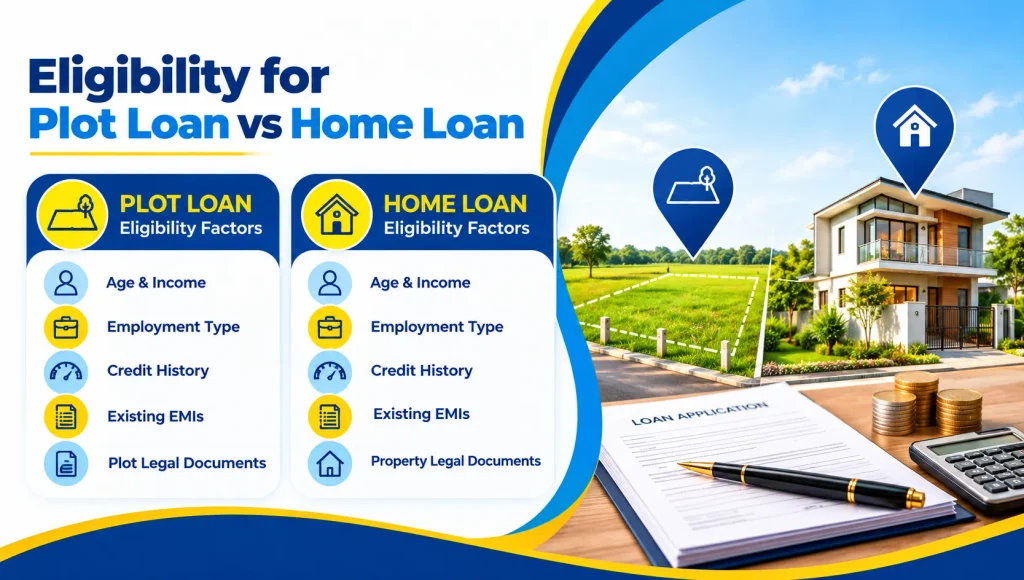
Eligibility depends on the property type, borrower profile, income, credit history, and lender rules. plot loan vs home loan A plot loan generally focuses on financing eligible residential land intended for construction, while a home loan covers eligible residential property purchase or construction. RBI housing-finance guidance recognizes loans for purchasing or constructing dwelling units and certain residential plot financing. Lenders typically assess your age, income, employment or business stability, existing EMIs, credit history, and property documents. They also check whether the property meets their legal and technical requirements. Before applying, compare eligibility criteria from multiple lenders because approval conditions can differ significantly.
Common Plot Loan Eligibility Factors
When you apply for a plot loan, lenders usually evaluate both you and the land. Your income and repayment capacity help the lender assess whether you can manage the proposed EMI. Your existing loans and monthly obligations also matter.
Common factors include:
- Age: Lenders set their own minimum and maximum age criteria.
- Income: Stable income can support repayment capacity.
- Employment: Salaried and self-employed applicants may qualify under different criteria.
- Credit history: Lenders review your repayment behaviour.
- Property eligibility: The plot must meet the lender’s residential and legal requirements.
- Documents: Title, sale, approval, and other land records require careful verification.
For example, if you earn ₹70,000 monthly but already pay ₹25,000 in EMIs, a lender may assess your remaining repayment capacity before considering a plot loan.
Common Home Loan Eligibility Factors
Home-loan eligibility follows similar financial checks but also places strong emphasis on the residential property’s legal and technical status. RBI guidance requires banks to consider factors such as sanctioned plans and applicable building requirements for financed residential properties.
| Eligibility Factor | What Lenders Generally Check |
| Age | Applicant’s age and expected repayment period |
| Income | Salary, business income, and stability |
| Credit history | Past repayment behaviour and outstanding debt |
| Existing EMIs | Current monthly financial commitments |
| Property | Title, approvals, valuation, and legal status |
| Employment | Job or business continuity |
| Documents | KYC, income, bank, and property records |
For example, a salaried buyer purchasing an apartment may qualify based on income and credit profile, but the lender must also accept the property’s documentation and valuation.
Why Credit Score Matters
Your credit score gives lenders an important view of your past borrowing behavior. plot loan vs home loan TransUnion CIBIL scores range from 300 to 900, with higher ranges generally indicating lower credit risk. Its published tiers place 731–770 in the “Prime” range, 771–790 in “Prime Plus,” and 791–900 in “Super Prime.
For example, imagine two applicants with similar incomes. Applicant A consistently pays existing EMIs on time, while Applicant B has several delayed payments. The lender may assess their applications differently because their credit histories show different risk levels. Your score does not guarantee loan approval or a particular interest rate, but a stronger credit profile can improve your access to credit and potentially support better terms. Always check your credit report for errors before applying.
Documents Required for Plot Loan and Home Loan
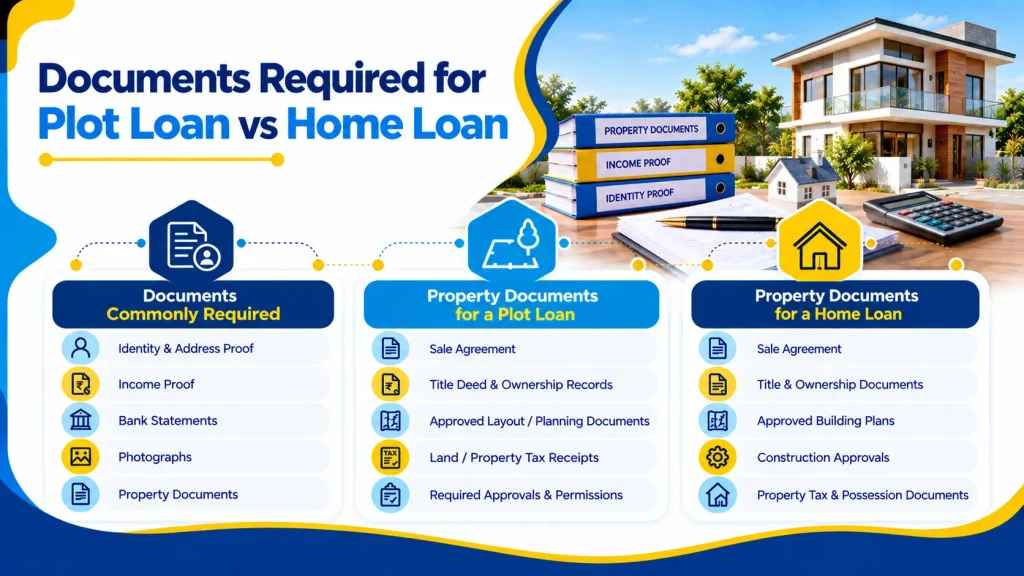
Applying for a property loan involves more than completing a loan application. Lenders need documents that verify your identity, income, repayment capacity, and property ownership. Plot loans require particular attention to land-related records, while home loans required plans and applicable statutory approvals for residential properties. Requirements vary by lender and applicant profile, so buyers should request the lender’s current checklist before submitting documents. Keeping clear copies of financial and property records can also reduce delays during verification. A well-organised document file helps you move through the application process more smoothly.
Documents Commonly Required
Most lenders request a core set of KYC, income, banking, and property documents. plot loan vs home loan Salaried applicants may need salary slips and employment details, while self-employed applicants may need business and income-tax records.
Common documents can include:
- Identity proof: PAN, Aadhaar, passport, or another accepted document.
- Address proof: Aadhaar, passport, utility bill, or accepted alternatives.
- Income proof: Salary slips, Form 16, income-tax returns, or business records.
- Bank statements: Recent statements that show income and financial activity.
- Photographs: Recent passport-size photographs where required.
- Property documents: Sale agreement, title documents, approvals, and related records.
For example, a salaried buyer applying for a ₹40 lakh home loan may need recent salary slips, bank statements, PAN, address proof, and the property’s legal documents. Exact requirements vary between lenders.
Property Documents for a Plot Loan
For a plot loan, the land documents play a central role in the lender’s assessment. plot loan vs home loan The lender needs to establish ownership, legal status, and whether the plot meets its financing conditions. RBI guidance also links eligible plot financing with the intention to construct a residential dwelling.
Depending on the lender and property, buyers may need:
- Sale agreement or agreement to sell
- Title deed or previous title documents
- Encumbrance-related records
- Approved layout or applicable planning documents
- Land/property tax receipts
- Survey or property identification details
- Required approvals or permissions
For example, if you plan to finance a ₹30 lakh residential plot, ask the lender to verify the title and applicable approvals before you commit to the purchase. plot loan vs home loan Never rely only on the seller’s document list; obtain professional legal verification where appropriate.
Property Documents for a Home Loan
Home-loan applications require documents that establish the property’s ownership, legal status, construction details, and value. The exact list depends on whether you purchase a ready-to-move-in property, plot loan vs home loan an under-construction home, or construct a house on your own land.
Typical documents may include:
- Sale agreement
- Title and ownership documents
- Approved building or layout plans
- Construction-related approvals
- Property tax records
- Possession or completion documents, where applicable
- Builder or project documents for applicable purchases
For example, someone buying a ₹60 lakh apartment may need the sale agreement, title documents, approved plans, and applicable completion or possession records. plot loan vs home loan A self-construction loan may require additional building plans, estimates, and approvals. Always confirm the current checklist with your lender, because document requirements can differ by property and loan type.
Interest Rates and Loan Tenure: Plot Loan vs Home Loan
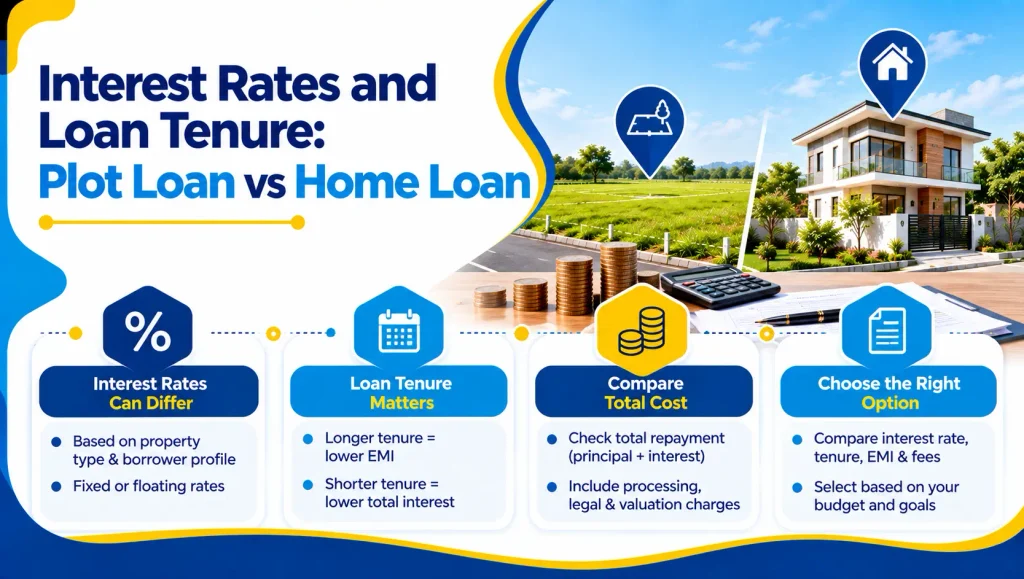
Interest rate and loan tenure directly affect your monthly EMI and total repayment. A plot loan and a home loan can carry different pricing and repayment conditions depending on the lender, borrower profile, property, and loan product. plot loan vs home loan For example, SBI’s published home-loan documentation allows repayment for up to 30 years, subject to its stated conditions. plot loan vs home loan RBI guidance also requires lenders to disclose applicable interest-rate and loan-related terms transparently. Buyers should therefore compare the interest rate, tenure, EMI, fees, and total repayment amount instead of choosing a loan based on one number alone.
How Interest Rates Can Differ
Interest rates can differ between plot loans and home loans because lenders assess the loan purpose, property, borrower profile, and repayment risk. Plot loan vs home loan Your income, credit history, existing EMIs, loan amount, and tenure can influence the rate offered to you. Floating-rate loans can also change over time when the underlying benchmark or applicable lending rate changes. SBI documentation, plot loan vs home loan for example, explains that floating rates can change and that such changes may affect EMI, repayment period, or both.
When comparing offers, check:
- Applicable interest rate
- Fixed or floating structure
- Benchmark and reset terms
- Processing charges
- Other applicable fees
- Prepayment conditions
Example: Two buyers may borrow ₹30 lakh but receive different offers because their credit profiles and loan terms differ.
Why Loan Tenure Matters
Loan tenure determines how long you repay the borrowed amount. A longer tenure can reduce the monthly EMI, but you may pay more interest over the entire loan period. Plot loan vs home loan A shorter tenure can increase the EMI while potentially reducing total interest.
| Tenure | Typical Effect on EMI | Potential Effect on Total Interest |
| Shorter | Higher EMI | Lower overall interest |
| Medium | Moderate EMI | Moderate interest |
| Longer | Lower EMI | Higher overall interest |
For example, if you borrow ₹30 lakh, extending the repayment period can make monthly payments easier to manage, but the additional years can increase your overall interest cost. plot loan vs home loans BI states that its home-loan maximum tenor can reach 30 years, subject to its conditions. Choose a tenure that balances your monthly budget with your long-term repayment cost.
Compare Total Cost, Not Just EMI
A low EMI can look attractive, but it does not always mean a lower borrowing cost. Always compare the total repayment, which includes the principal and interest, along with applicable processing, legal, valuation, and other charges. plot loan vs home Loans BI’s published documentation, for example, lists processing, legal opinion, and valuation-related charges among applicable loan costs.
Example: Suppose Buyer A chooses a longer tenure with a ₹25,000 EMI, while Buyer B chooses a shorter tenure with a ₹30,000 EMI. plot loan vs home loan. Buyer A may enjoy a lower monthly burden but could pay more interest over time.
Before signing, compare:
- Monthly EMI
- Total interest
- Processing fees
- Legal and valuation charges
- Prepayment terms
- Overall repayment amount
This approach gives you a clearer picture of the actual cost of borrowing.
Conclusion
Choosing between a plot loan and a home loan depends on what you plan to buy, how you intend to use the property, and what repayment structure fits your finances. plot loan vs home loan A plot loan can support the purchase of eligible residential land, while a home loan can help finance an eligible house or residential construction. Before making a decision, compare interest rates, loan tenure, EMI, total repayment, eligibility requirements, documentation, and applicable tax considerations. Most importantly, verify the property’s legal documents and understand the lender’s terms before signing an agreement
FAQs
1. What is the difference between a plot loan and a home loan?
A plot loan finances eligible residential land, while a home loan generally finances a house purchase or construction.
2. Can I use a plot loan to buy residential land?
Yes, eligible residential plots may qualify, subject to the lender’s requirements and conditions.
3. Is a plot loan different from a home loan?
Yes, lenders may apply different eligibility criteria, interest rates, tenure, and property conditions.
4. Can I construct a house after taking a plot loan?
Yes, but construction requirements and timelines depend on the lender and loan agreement.
5. Which documents are needed for a plot loan?
You generally need KYC, income, banking, title, sale, and other property-related documents.
6. Which loan has a lower interest rate?
Rates vary by lender, borrower profile, loan product, and prevailing market conditions.
7. Can I get tax benefits on a plot loan?
Tax treatment depends on the loan purpose, construction status, applicable rules, and individual circumstances.
8. Does credit score affect plot loan eligibility?
Yes, lenders consider credit history along with income, existing obligations, and other eligibility factors.
9. Can I get a home loan for constructing a house?
Yes, eligible construction loans can finance house construction, subject to lender requirements and approvals.
10. How should I choose between a plot loan and home loan?
Compare your property goal, eligibility, EMI, total interest, tenure, fees, documentation, and repayment capacity.