Enquire Now for a free site visit – call

Introduction
Buying a plot is exciting but many buyers underestimate the plot registration cost, leading to unexpected financial strain at the final stage. In Tamil Nadu, registration charges significantly impact your total property budget. According to the Department of Registration Tamil Nadu, property transactions contribute thousands of crores annually in stamp duty revenue, reflecting how substantial these charges are for buyers. Additionally, as per the Ministry of Housing and Urban Affairs, rising urban land demand continues to push property values upward increasing registration costs proportionally.
Before you finalize your purchase, you must understand:
- How stamp duty and registration fees are calculated
- The impact of guideline value vs market value
- The exact percentage payable in Tamil Nadu
- How to accurately estimate total registration expenses
This guide simplifies everything with clear formulas, examples, and a 2026-ready calculator approach so you can budget smartly and avoid surprises.
What Is Plot Registration Cost in Tamil Nadu?
Plot registration cost in Tamil Nadu includes:
- 7% Stamp Duty
- 4% Registration Fee
Total = 11% of the higher value between Sale Value or Guideline Value
For example, if your plot value is ₹10,00,000, you will pay ₹1,10,000 as registration cost.
When you buy a plot in Tamil Nadu, the government collects a mandatory fee to legally transfer ownership. This total cost includes stamp duty and registration charges, governed by the Department of Registration Tamil Nadu.
Components of Plot Registration Cost
- Stamp Duty (7%) – Tax on property transaction
- Registration Fee (4%) – Charge to officially record the sale
- Guideline Value Rule – Charges apply on whichever is higher: sale price or guideline value
According to the Indian Stamp Act, 1899, buyers must pay stamp duty to validate property transfers legally.
Example Calculation
| Property Value | Stamp Duty (7%) | Registration (4%) | Total Cost (11%) |
| ₹5,00,000 | ₹35,000 | ₹20,000 | ₹55,000 |
| ₹10,00,000 | ₹70,000 | ₹40,000 | ₹1,10,000 |
| ₹25,00,000 | ₹1,75,000 | ₹1,00,000 | ₹2,75,000 |
If the guideline value exceeds your sale price, the government calculates charges based on the higher amount.
Key Takeaway
- Budget at least 11% of property value
- Always verify guideline value before payment
- Plan funds in advance to avoid last-minute stress
Understanding plot registration cost helps you avoid surprises and ensures smooth property ownership transfer.
Stamp Duty and Registration Charges in Tamil Nadu (2026 Updated)
When you calculate plot registration cost in Tamil Nadu in 2026, you must factor in two compulsory charges set by the state government. The Department of Registration Tamil Nadu currently applies the following rates:
Current Charges (2026)
- Stamp Duty – 7% of the property value
- Registration Fee – 4% of the property value
- Total Payable – 11% of the higher value (Sale Price or Guideline Value)
These rates apply uniformly across districts, including Chennai, Coimbatore, and Madurai.
Example Calculations
Let’s break it down with simple examples:
- If your plot costs ₹8,00,000
- Stamp Duty (7%) = ₹56,000
- Registration Fee (4%) = ₹32,000
- Total = ₹88,000
- Stamp Duty (7%) = ₹56,000
- If your sale price is ₹12,00,000 but the guideline value is ₹14,00,000
- Charges apply on ₹14,00,000
- Total Registration Cost (11%) = ₹1,54,000
- Charges apply on ₹14,00,000
You cannot choose the lower amount. The government always considers the higher value to prevent undervaluation.
Under the Indian Stamp Act, 1899, stamp duty validates the transaction legally.
How to Calculate Plot Registration Cost (Step-by-Step Guide)
You can calculate your plot registration cost in Tamil Nadu easily if you follow a simple formula. You just need the correct property value and the current 11% charge (7% stamp duty + 4% registration).
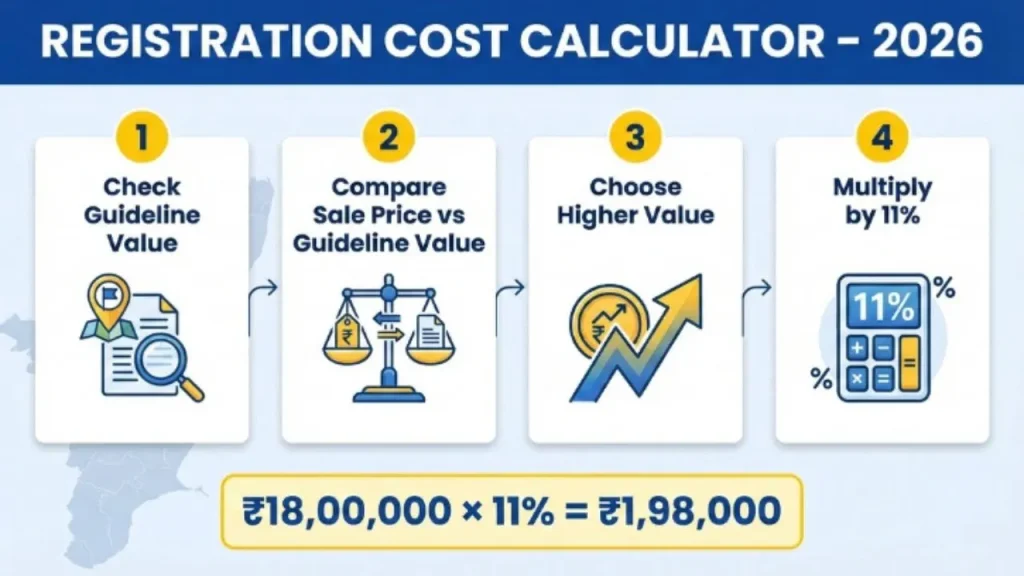
Step 1: Check the Guideline Value
Before you calculate anything, verify the guideline value from the Department of Registration Tamil Nadu portal.
- Compare Sale Price mentioned in the agreement
- Compare Government Guideline Value
- Choose the higher value
👉 The government always calculates charges on the higher amount.
Step 2: Apply the 11% Formula
Use this simple formula:
Total Registration Cost = Property Value × 11%
Step 3: Calculate with Example
Suppose:
- Sale Price = ₹15,00,000
- Guideline Value = ₹18,00,000
Since ₹18,00,000 is higher, calculate charges on that amount.
| Description | Calculation | Amount |
| Stamp Duty (7%) | 18,00,000 × 7% | ₹1,26,000 |
| Registration Fee (4%) | 18,00,000 × 4% | ₹72,000 |
| Total Cost (11%) | 18,00,000 × 11% | ₹1,98,00 |
2026 Plot Registration Cost Calculator
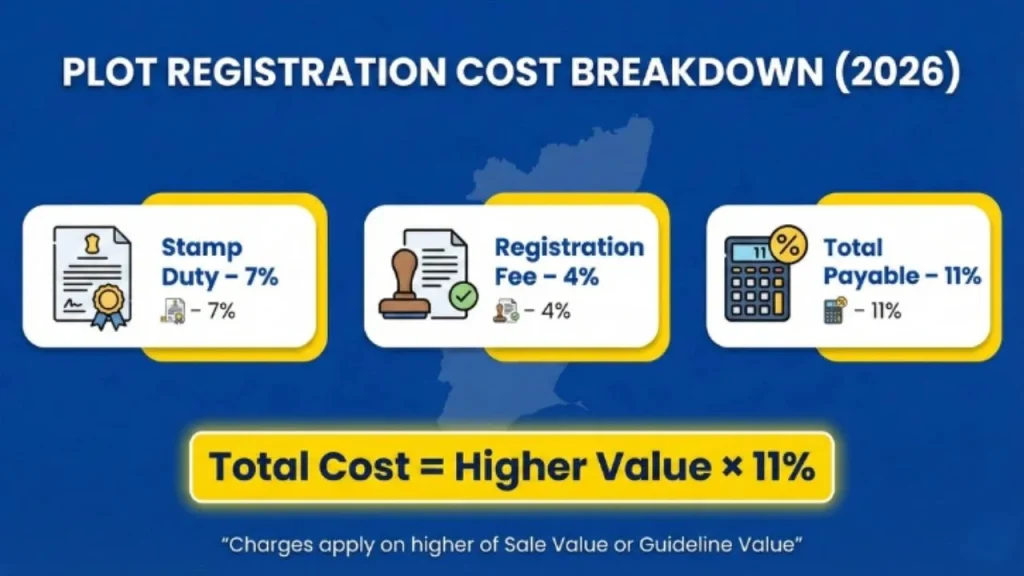
You can estimate your plot registration cost in Tamil Nadu (2026) quickly if you apply the standard 11% rule. The Department of Registration Tamil Nadu currently charges:
- 7% Stamp Duty
- 4% Registration Fee
- Total = 11% of property value
Let’s look at practical examples so you can plan your budget confidently.
Example Registration Cost Table (2026)
| Plot Value | Stamp Duty (7%) | Registration (4%) | Total Cost (11%) |
| ₹5,00,000 | ₹35,000 | ₹20,000 | ₹55,000 |
| ₹10,00,000 | ₹70,000 | ₹40,000 | ₹1,10,000 |
| ₹20,00,000 | ₹1,40,000 | ₹80,000 | ₹2,20,000 |
| ₹30,00,000 | ₹2,10,000 | ₹1,20,000 | ₹3,30,000 |
How to Use This Table
- Identify your higher value (Sale Price or Guideline Value).
- Multiply it by 11%.
- Keep that amount ready before registration day.
For example:
If your plot costs ₹25,00,000, you will pay:
- ₹1,75,000 as stamp duty
- ₹1,00,000 as registration fee
- Total = ₹2,75,000
Guideline Value vs Market Value What Buyers Must Know
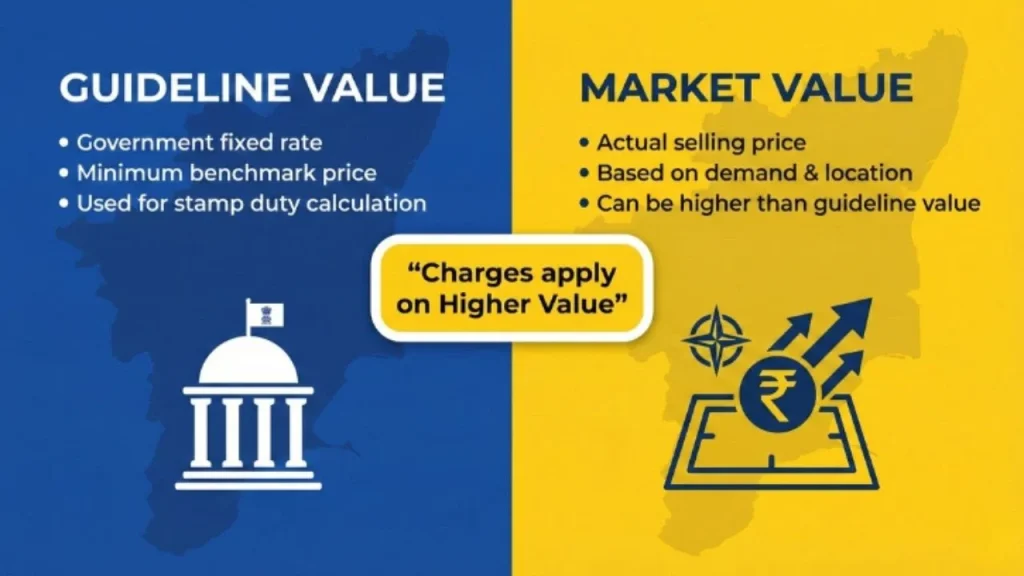
When you calculate plot registration cost, you must understand the difference between guideline value and market value. Many buyers confuse these two terms and end up miscalculating their registration budget.
What Is Guideline Value?
The Tamil Nadu government fixes a minimum property value for every area. The Department of Registration Tamil Nadu publishes this rate to prevent undervaluation during property transactions.
- It acts as the minimum benchmark price
- Authorities use it to calculate stamp duty
- It may differ from the actual selling price
What Is Market Value?
Market value reflects the actual price buyers and sellers agree upon.
- It depends on demand, location, road access, and development
- It often exceeds guideline value in prime areas
- It fluctuates based on real estate trends
Example for Better Understanding
Suppose:
- Market Value = ₹22,00,000
- Guideline Value = ₹18,00,000
In this case, the government calculates registration charges on ₹22,00,000 because it is higher.
Now consider another scenario:
- Market Value = ₹15,00,000
- Guideline Value = ₹17,00,000
Here, you must pay charges based on ₹17,00,000.
Additional Charges While Registering a Plot
When you calculate your plot registration cost, don’t stop at stamp duty and registration fees. Several smaller charges add up during the registration process. If you ignore them, you may face last-minute cash pressure at the Sub-Registrar Office.
Here are the common additional expenses you should plan for:
1. Legal Fees
You may hire a property lawyer to verify documents and draft the sale deed.
- Title verification charges
- Legal opinion fees
- Sale deed drafting cost
👉 Example: If you buy a ₹20 lakh plot, you may pay a lawyer to check 30 years of title records before registration.
2. Encumbrance Certificate (EC) Charges
You must obtain an EC to confirm that no loans or disputes exist on the property.
- Application fee
- Copy charges
This step protects you from hidden liabilities.
3. Patta Transfer Charges
After registration, you need to transfer the patta to your name.
- Application processing fee
- Revenue department charges
Without patta transfer, you cannot prove full ownership for future resale.
4. Document Writer / Service Charges
Many buyers use document writers near the Sub-Registrar Office.
- Data entry fees
- Appointment booking assistance
- Biometric processing help
Smart Planning Tip
Keep an additional buffer beyond the 11% registration cost. When you prepare in advance, you avoid stress and complete your property registration smoothly.
District-Wise Differences in Tamil Nadu
When you calculate plot registration cost in Tamil Nadu, you must understand one important point: stamp duty and registration fees remain the same across the state, but guideline values vary by district and locality. This difference directly affects how much you pay.
The Department of Registration Tamil Nadu applies uniform rates:
- 7% Stamp Duty
- 4% Registration Fee
- Total = 11%
However, the guideline value changes from district to district, and even street to street.
How District Differences Impact You
Here’s how variation works:
- Prime urban areas usually have higher guideline values
- Developing suburbs may have moderate values
- Semi-urban or rural areas often have lower benchmark rates
Example Comparison
Imagine you buy two similar-sized plots:
- In Chennai – Guideline value stands higher, so you pay more registration cost.
- In Madurai – Guideline value may be lower, so total payable reduces.
Even within Chennai:
- Central business areas cost more
- Outer zones like developing layouts may cost less
What Buyers Should Do
- Check the exact guideline value for your street
- Compare nearby areas before finalizing
- Calculate registration cost using the higher applicable value
When you research district-wise differences properly, you make smarter investment decisions and avoid budgeting mistakes.
Is There Any Stamp Duty Exemption in Tamil Nadu?
Many buyers ask this question before calculating their plot registration cost: Can I get a stamp duty exemption in Tamil Nadu? The answer depends on the type of transaction and the relationship between parties. The Department of Registration Tamil Nadu allows certain concessions in specific cases.
Here’s what you should know:
1. Concessions for Family Transfers
When you transfer property between close family members, the government may charge reduced stamp duty.
- Transfer between parents and children
- Transfer between spouses
- Settlement deeds within family
👉 Example: If a father settles a plot in his daughter’s name, authorities may apply concessional charges instead of full 7%.
2. Gift Deed Benefits
If you register a gift deed among eligible family members:
- You may pay a reduced stamp duty
- Registration fees may also have a cap
Always confirm eligibility before assuming concession.
3. Women Buyers
Tamil Nadu does not currently offer a separate reduced stamp duty rate exclusively for women buyers. Buyers must pay the standard 7% unless the transaction qualifies under another concession category.
Important Reminders
- Confirm current rules before registration
- Verify eligibility at the Sub-Registrar Office
- Do not rely on verbal promises
When you understand exemptions clearly, you avoid confusion and plan your registration expenses accurately.
Plot Registration Process in Tamil Nadu (2026)
When you buy a plot, you must complete the registration process to secure legal ownership. The Department of Registration Tamil Nadu manages the entire procedure through Sub-Registrar Offices across the state. If you follow the correct steps, you can finish registration smoothly without delays.
Here’s how the process works in 2026:
Step 1: Draft the Sale Deed
- Prepare the sale deed with accurate property details
- Include buyer and seller identification
- Mention the correct sale value
👉 Many buyers hire a lawyer to avoid drafting errors.
Step 2: Verify Documents
- Check title history
- Review Encumbrance Certificate (EC)
- Confirm layout approval
This step protects you from legal complications.
Step 3: Pay Stamp Duty and Registration Fees
- Calculate 11% of the higher value
- Make payment through the official portal or authorized methods
Keep payment receipts ready.
Step 4: Book Appointment at Sub-Registrar Office
- Select convenient date and time
- Ensure both buyer and seller attend
Step 5: Biometric Verification and Document Submission
- Provide fingerprints and photographs
- Submit original documents
Step 6: Collect Registered Document
After verification, the office records the transaction and issues the registered document.
When you follow these steps carefully, you secure your plot ownership without unnecessary stress.
Why Trust This Guide?
When you research plot registration cost, you will find dozens of articles. But not all guides explain the rules clearly or reflect Tamil Nadu’s actual registration framework. This guide focuses on accuracy, clarity, and practical application.
We base the information on rules issued by the Department of Registration Tamil Nadu and legal provisions under the Indian Stamp Act, 1899. Instead of vague advice, we provide step-by-step explanations and realistic examples.
What Makes This Guide Reliable?
- We explain current 7% stamp duty and 4% registration charges clearly
- We show how guideline value affects your final payable amount
- We include calculation examples you can apply immediately
- We highlight common mistakes buyers make
👉 Example: If guideline value exceeds your sale price, you now know to calculate charges on the higher amount. Many blogs fail to clarify this.
Practical, Buyer-Focused Approach
- We use simple language instead of legal jargon
- We provide structured tables and bullet points
- We encourage verification with official sources
Smart Budget
Before you calculate your plot registration cost, choose a project that offers transparent pricing and legal clarity. Explore verified plots with clear documentation at Tiruthanikai Infra City and invest with confidence.
👉 Visit:https://tiruthanikaiinfracity.com/
Conclusion: Plan Smart, Register Confidently
Understanding plot registration cost is not just about knowing percentages it’s about protecting your investment. When you clearly calculate the 11% (7% stamp duty + 4% registration fee) and compare guideline value vs market value, you avoid last-minute financial stress and legal surprises.
Before you register your plot, remember to:
- Check the correct guideline value
- Budget at least 11–12% extra
- Verify layout approvals and title documents
- Account for additional legal and documentation charges
A well-planned registration process ensures smooth ownership transfer and long-term peace of mind. Property is a major financial decision, and small mistakes can cost big money. When you stay informed, you stay in control.
Now that you understand how plot registration charges work in Tamil Nadu (2026), you can calculate confidently, budget accurately, and complete your property purchase without confusion.
Make informed decisions today because smart buyers don’t just purchase land, they secure their future.
Frequently Asked Questions
1. What is the total plot registration cost in Tamil Nadu?
You must pay 11% of the higher value (Sale Price or Guideline Value).
7% Stamp Duty
4% Registration Fee
👉 Example: If your plot value is ₹12,00,000, your total registration cost will be ₹1,32,000.
2. Do registration charges vary by district?
No. The rates remain the same across Tamil Nadu. However, guideline values differ by location, which affects the final amount you pay.
3. What happens if the guideline value is higher than the sale price?
The government calculates charges on the higher value.
For example:
Sale Price = ₹15,00,000
Guideline Value = ₹18,00,000
You must pay 11% on ₹18,00,000.
4. Can I reduce plot registration cost legally?
You cannot reduce statutory rates. However, you can:
Verify the correct guideline value
Check eligibility for family transfer concessions
Avoid valuation mistakes
5. Is registration mandatory for plots?
Yes. The law requires you to register property transactions under the Registration Act, 1908. Without registration, you cannot claim legal ownership.